
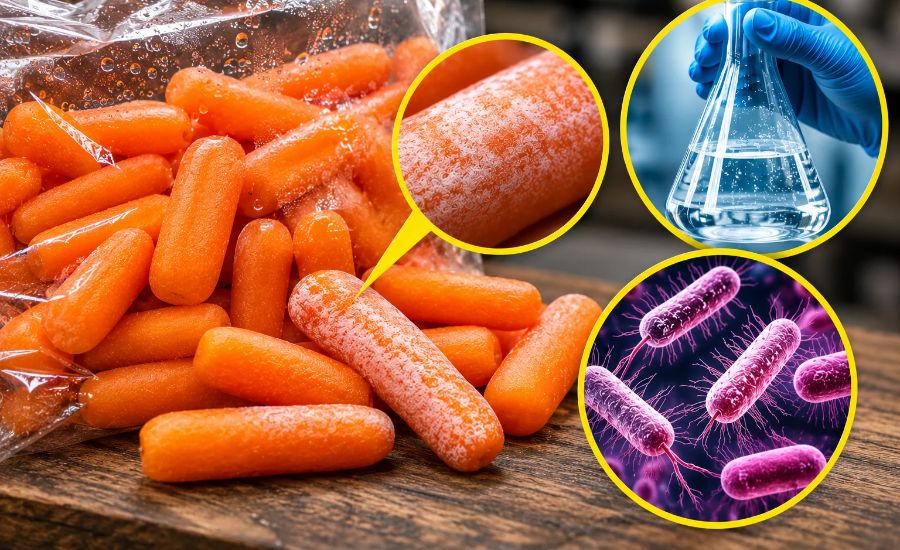

Baby carrots have become one of the most convenient and popular healthy snacks in American supermarkets. They’re sweet, crunchy, easy to pack, and often marketed as a nutritious alternative to processed foods.
But a disturbing claim circulating on social media has left consumers questioning whether these familiar orange vegetables are as healthy as they appear.
Viral posts warn people to never consume packaged baby carrots, alleging that they are soaked in chemicals, treated with bleach, and potentially dangerous to human health.
Some even suggest that baby carrots could contribute to cancer or other chronic illnesses.
The controversy has gained further attention following a major food safety recall involving organic carrots contaminated with potentially dangerous bacteria.
So what’s really happening behind the scenes?
Are baby carrots processed with chlorine? Can their packaging hide harmful contamination? And should consumers stop buying them altogether?
The answers reveal important differences between legitimate food safety concerns and misleading claims that have circulated for years.
What Are Baby Carrots Really Made From?
One surprising fact about baby carrots is that many aren’t actually young carrots.
Most packaged baby-cut carrots sold in supermarkets begin as fully grown carrots that are trimmed, peeled, and shaped into smaller, uniform pieces.
Manufacturers use specialized equipment to cut larger carrots into convenient snack-sized portions.
The carrots are then polished, washed, packaged, and refrigerated before distribution.
This process explains why supermarket baby carrots often look remarkably similar in size and shape.
True baby carrots also exist. These are carrots harvested before reaching full maturity, usually with a more delicate appearance and sometimes with their green tops still attached.
However, the smooth, rounded carrots commonly found in plastic bags are generally baby-cut carrots.
The fact that they have been mechanically processed doesn’t automatically make them unhealthy.
Peeling and cutting are common food preparation techniques, and the nutritional composition remains broadly similar to that of ordinary carrots.
Are Baby Carrots Really Washed With Chlorine?
One of the most controversial aspects of commercial baby carrot production involves the use of sanitizing solutions.
Some manufacturers use carefully controlled, diluted chlorine-based washes during processing to reduce potentially harmful microorganisms.
This practice is not unique to carrots.
Sanitizing washes may also be used during commercial processing of lettuce, spinach, and other fresh-cut vegetables.
Because removing the protective outer surface exposes additional plant tissue, freshly cut vegetables can become more susceptible to microbial contamination.
Food processors therefore use sanitation procedures to reduce the risk of pathogens such as E. coli and Salmonella.
The distinction is that food-grade sanitizing solutions used under regulated conditions are not equivalent to soaking vegetables in concentrated household bleach.
Manufacturers must follow applicable food safety requirements governing these substances and their use.
Furthermore, products are generally rinsed or otherwise processed according to established safety procedures.
There is no credible evidence that consuming properly processed baby carrots causes cancer because chlorine-based washing solutions may have been used during production.
Claims suggesting that packaged carrots are saturated with dangerous bleach residues are not supported by established food safety evidence.
Why Do Baby Carrots Sometimes Turn White?
Consumers sometimes discover that baby carrots develop a pale, chalky appearance after spending several days in the refrigerator.
This phenomenon has generated another persistent rumor.
Some social media posts claim that the white coating represents chlorine residue or chemical contamination.
However, scientists have identified a much simpler explanation.
The discoloration is commonly called white blush.
It develops primarily because moisture evaporates from the exposed surfaces of peeled carrots.
As the outer carrot tissue becomes dehydrated, microscopic changes in the surface alter how light reflects from it, producing a whitish appearance.
Research has shown that dehydration and structural changes in superficial plant cells contribute significantly to this effect.
The discoloration itself is not evidence of toxic chemical contamination.
Carrots affected by mild white blush may still be safe to eat if they have been stored properly and show no signs of spoilage.
However, carrots that become slimy, develop mold, smell unpleasant, or show obvious deterioration should be discarded.
The Serious E. Coli Outbreak That Put Baby Carrots in the Spotlight
Although many online warnings about baby carrots exaggerate chemical risks, there have been legitimate food safety problems involving packaged carrots.
In November 2024, U.S. health authorities investigated a multistate outbreak of E. coli O121:H19 infections associated with organic whole and baby carrots.
The investigation identified products supplied by Grimmway Farms, a major American carrot producer.
On November 16, 2024, the company initiated a voluntary recall involving multiple brands and quantities of packaged organic carrots.
The recalled carrots had been sold through several major grocery retailers.
The outbreak prompted warnings from the Centers for Disease Control and Prevention and the Food and Drug Administration.
Some infected individuals experienced severe gastrointestinal symptoms, and the outbreak was associated with hospitalizations and a death.
Unlike the unsubstantiated chlorine-related cancer allegations, this was a documented foodborne illness outbreak supported by epidemiological and product-tracing investigations.
What Made the Contamination So Dangerous?
The bacteria involved in the outbreak belonged to a group known as Shiga toxin-producing Escherichia coli, commonly abbreviated as STEC.
While many strains of E. coli naturally occur in the intestines without causing illness, certain strains can produce powerful toxins.
Infections may cause severe stomach cramps, diarrhea that can become bloody, nausea, and vomiting.
In some patients, complications can become life-threatening.
One particularly serious complication is hemolytic uremic syndrome, or HUS.
This condition can damage the kidneys and may require hospitalization.
Young children, older adults, and individuals with certain medical vulnerabilities may face a greater risk of severe illness.
The 2024 outbreak demonstrated why food safety monitoring remains essential even for vegetables promoted as organic and nutritious.
Importantly, organic certification does not guarantee that produce is free from disease-causing microorganisms.
Contamination can occur during growing, harvesting, processing, transportation, or packaging.
Were Organic Baby Carrots Also Affected?
Yes.
The 2024 recall involved organic carrots, which surprised some consumers who assumed that organic produce was automatically safer.
Organic certification primarily addresses specific agricultural production standards, including restrictions on certain pesticides and fertilizers.
It does not mean that vegetables cannot become contaminated with harmful bacteria.
Organic and conventionally grown produce can both be affected by foodborne pathogens.
During the recall, affected products were distributed under numerous retail brand names, including Simple Truth Organic, among others.
However, this historical recall should not be interpreted as evidence that every bag of those brands is currently unsafe.
Recalls apply to specific products, production batches, distribution periods, and dates.
Consumers should always consult current official recall information rather than assume that an entire brand remains dangerous indefinitely.
Can Washing Baby Carrots Remove Dangerous Bacteria?
Washing fresh vegetables is an important food safety practice, but it has limitations.
Rinsing produce under clean running water can help remove dirt and reduce some microorganisms present on the surface.
However, washing cannot guarantee the complete elimination of dangerous bacteria.
Certain microorganisms may attach tightly to vegetable surfaces or become trapped in microscopic irregularities.
This is why consumers should never assume that rinsing recalled produce makes it safe to eat.
If a product has been recalled because of possible E. coli contamination, the safest action is to discard it or follow the recall instructions.
The FDA also advises against washing produce with household soap, detergents, or cleaning chemicals.
These substances are not intended for consumption and may leave harmful residues.
Cooking vegetables thoroughly can destroy many disease-causing microorganisms, although recalled produce should still be discarded rather than treated as safe through home preparation.
Are Baby Carrots Less Nutritious Than Whole Carrots?
Despite their commercial processing, baby-cut carrots remain a nutritious vegetable.
They provide important nutrients and naturally occurring plant compounds, including beta-carotene, dietary fiber, potassium, and vitamin K.
Beta-carotene is especially notable because the body can convert it into vitamin A as needed.
Vitamin A supports normal vision, immune function, and the maintenance of healthy skin and mucous membranes.
Carrots also contain carotenoids and other antioxidant compounds that contribute to a balanced diet.
Peeling can remove some nutrients and beneficial compounds concentrated near the outer surface.
However, this does not eliminate the nutritional value of baby-cut carrots.
For most healthy individuals, packaged baby carrots can be part of a nutritious diet.
Why Do Packaged Baby Carrots Last So Long?
Another concern involves the shelf life of commercially packaged carrots.
Some consumers question how peeled and cut vegetables can remain fresh for extended periods.
The answer involves a combination of refrigeration, moisture management, sanitation, and packaging.
Fresh-cut carrots are typically stored at low temperatures to slow microbial growth and deterioration.
Packaging also helps maintain moisture and reduce dehydration.
Commercial processing facilities use quality control systems designed to minimize contamination and extend freshness.
However, refrigeration does not make food permanently safe.
Over time, packaged vegetables can still deteriorate or become unsafe if improperly stored.
Consumers should follow storage instructions and use products within their recommended freshness period.
Should You Choose Whole Carrots Instead?
Whole carrots offer several practical advantages.
Because they retain their natural outer structure until preparation, they may experience less surface damage during processing.
They are also often less expensive than conveniently packaged baby-cut carrots.
Buying whole carrots allows consumers to wash, peel, and cut them immediately before eating.
This approach may reduce packaging waste and provides greater control over food preparation.
However, whole carrots are not automatically free from contamination.
Pathogens can affect vegetables regardless of whether they are sold whole, peeled, organic, or conventionally grown.
The best choice depends on personal preferences, convenience, cost, and proper food handling.
How to Reduce the Risks When Eating Baby Carrots
Consumers can take several straightforward precautions when purchasing and preparing packaged carrots.
- Check for recalls. Follow official FDA and CDC announcements concerning specific products and batches.
- Keep carrots refrigerated. Store packaged carrots according to their labeling and avoid leaving them at room temperature for extended periods.
- Inspect the packaging. Avoid damaged, leaking, swollen, or improperly refrigerated packages.
- Watch for spoilage. Discard carrots that become slimy, moldy, or develop an unpleasant odor.
- Practice good kitchen hygiene. Keep vegetables separate from raw meat and other potential sources of contamination.
- Wash fresh produce appropriately. Use clean running water when washing is needed, not soap or household disinfectants.
These precautions help reduce preventable food safety risks without unnecessarily eliminating nutritious vegetables from the diet.
Why Do Viral Health Warnings Spread So Quickly?
The claim that people should never eat baby carrots illustrates how legitimate facts can become mixed with exaggerated conclusions.
There are three separate issues involved.
First, some commercial carrot processors use diluted sanitizing solutions, including chlorine-based treatments, to reduce microbial contamination.
Second, baby carrots can develop a white surface discoloration caused primarily by dehydration.
Third, specific batches of packaged carrots have been associated with documented foodborne illness outbreaks.
Each of these statements has a factual basis.
However, combining them into the claim that all baby carrots are chemically dangerous or cause cancer creates a misleading impression.
Sensational food warnings often spread because they involve everyday products consumed by millions of people.
When a familiar food is portrayed as secretly dangerous, readers may react strongly before examining the evidence.
This makes accurate scientific communication particularly important.
Final Thoughts: Should You Stop Eating Baby Carrots?
The warning that nobody should ever consume baby carrots is not supported by scientific evidence.
Baby-cut carrots are generally nutritious and safe when produced, handled, and stored according to established food safety standards.
Although some manufacturers use regulated chlorine-based washes, this does not mean that carrots contain dangerous amounts of bleach or cause cancer.
The white coating that sometimes appears on their surface is usually a harmless result of dehydration.
However, the 2024 E. coli outbreak serves as an important reminder that even healthy, organic, and minimally processed foods can occasionally become contaminated.
The most effective response is not to fear an entire category of vegetables but to stay informed about recalls, follow proper storage instructions, and maintain good food hygiene.
Would you continue buying packaged baby carrots, or would you rather choose whole carrots and prepare them yourself?



Leave a Reply
You must be logged in to post a comment.