
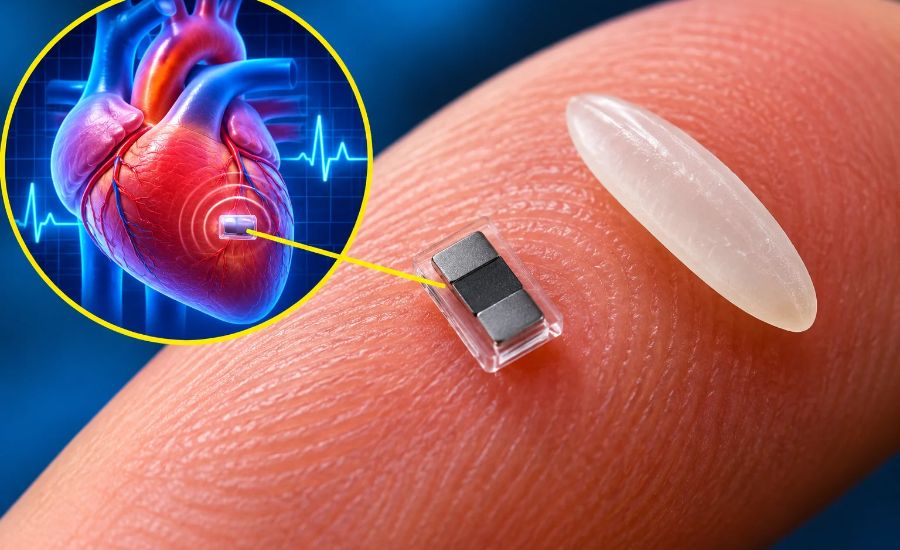

Scientists have developed a revolutionary pacemaker smaller than a grain of rice that could transform how doctors treat certain heart rhythm problems, particularly in newborn babies and patients recovering from cardiac surgery.
Unlike conventional pacemakers, the experimental device requires no connecting wires, contains no conventional battery, and is designed to dissolve naturally inside the body once its job is complete.
Even more remarkably, the miniature pacemaker can be activated using light transmitted through the skin, allowing doctors to help regulate the heartbeat without the external wires typically associated with temporary cardiac pacing.
The breakthrough, announced by researchers at Northwestern University in April 2025 and published in the prestigious scientific journal Nature, represents a major advancement in bioelectronic medicine.
But perhaps the most extraordinary feature is what happens after the heart no longer needs assistance.
Instead of requiring another procedure to remove the device, its specially engineered components gradually dissolve into the body’s fluids.
The technology could eventually make temporary heart pacing safer, less invasive, and more accessible to vulnerable patients.
However, the pacemaker remains experimental and has not yet been approved for routine clinical use in humans.
A Pacemaker Smaller Than a Grain of Rice
Traditional pacemakers have saved millions of lives by helping maintain a stable heartbeat when the heart’s natural electrical system fails to function properly.
These devices deliver electrical impulses that stimulate the heart muscle and help regulate its rhythm.
Although modern pacemakers have become considerably smaller and more sophisticated, conventional systems generally require implantation procedures and may contain batteries, electronic components, and connecting leads.
Temporary pacemakers used after heart surgery can also involve wires that extend outside the patient’s body.
Researchers at Northwestern University wanted to develop a radically different solution.
Their invention measures approximately 1.8 millimeters wide, 3.5 millimeters long, and just 1 millimeter thick.
That makes it smaller than a typical grain of rice.
The device is so compact that it can fit inside the tip of a syringe, potentially allowing implantation using minimally invasive methods.
Its tiny size could be particularly valuable when treating newborn babies whose hearts are too small and delicate for certain conventional pacing approaches.
How Does the Tiny Pacemaker Work?
The miniature device combines several innovative technologies to stimulate the heart without requiring traditional connecting wires.
Its operation depends on a wireless system controlled by light.
A soft, flexible patch worn on the patient’s chest monitors the heart’s activity.
When the system detects that pacing support is necessary, the wearable patch emits pulses of light that penetrate the skin and reach the implanted pacemaker.
A miniature light-sensitive component inside the device responds to these signals.
This activates the pacemaker, allowing it to deliver electrical stimulation to the heart.
The system is designed to provide pacing support when required rather than continuously stimulating the heart unnecessarily.
Another remarkable feature is how the device generates electricity.
Instead of relying on a traditional battery, the miniature pacemaker uses two different metallic electrodes that interact with the body’s natural fluids.
These fluids function as an electrolyte, allowing a small electrochemical current to form.
When activated by light, the device uses this electrical energy to stimulate the heart muscle.
The combination of light-based control, miniaturized electronics, and biodegradable materials makes the invention fundamentally different from many existing pacemaker systems.
Why Does the Pacemaker Dissolve Inside the Body?
One of the biggest challenges with temporary pacemakers is removing them after they are no longer needed.
Following certain heart surgeries, patients may temporarily require electrical pacing while their hearts recover.
Conventional temporary pacing systems often use wires attached to the heart.
These wires must eventually be removed, and although removal is generally performed safely, complications can occasionally occur.
Potential problems include bleeding, infection, tissue damage, and other procedural risks.
The new pacemaker was designed to eliminate the need for device retrieval.
Its components are made from biocompatible, bioresorbable materials engineered to gradually break down after completing their intended function.
This concept is similar to absorbable surgical stitches, which dissolve as tissues heal.
Researchers can adjust the materials and their thicknesses to influence how long the pacemaker remains functional before degrading.
The goal is to provide electrical support during the critical recovery period and then allow the device to disappear without requiring additional removal procedures.
However, its long-term safety and dissolution characteristics still need to be evaluated in human clinical trials.
Why This Breakthrough Could Be Especially Important for Babies
The development team has emphasized that children, particularly newborns with congenital heart defects, were a major motivation behind the invention.
Congenital heart defects affect the structure or function of the heart and may require corrective surgery early in life.
Following surgery, some babies experience temporary disturbances in their heart’s electrical conduction system.
These disturbances can cause an abnormally slow heartbeat or other rhythm problems.
In certain cases, temporary pacing is necessary while the heart recovers.
However, placing conventional temporary pacing wires in a newborn presents unique challenges.
A baby’s heart is extremely small, and delicate tissues may be more vulnerable to complications.
The newly developed pacemaker could offer a less invasive alternative.
Its miniature dimensions potentially allow doctors to place the device directly where electrical stimulation is needed.
The external wearable patch could then control the pacing without traditional wires extending from the heart.
If future clinical trials demonstrate safety and effectiveness, this technology could become particularly valuable in pediatric cardiac care.
Does the Device Actually Heal the Heart?
Some viral social media posts describe the invention as a pacemaker that heals the heart before dissolving.
This description is misleading.
The pacemaker does not regenerate damaged heart tissue, cure congenital heart defects, or reverse underlying cardiovascular disease.
Its purpose is to provide temporary electrical support to help the heart maintain an appropriate rhythm during recovery.
For example, when a patient undergoes surgery to correct a structural heart defect, the heart’s electrical conduction system may need time to recover.
Temporary pacing can help maintain circulation while natural electrical function returns.
Once the heart no longer requires assistance, the temporary device may no longer be necessary.
Therefore, the invention supports the heart during healing, rather than directly healing or rebuilding damaged heart tissue.
This distinction is important because the technology is designed for a specific medical function, not as a universal treatment for heart disease.
How Is This Different From a Traditional Pacemaker?
Conventional pacemakers are typically designed to remain inside the body for years.
They are commonly used to manage persistent conditions involving abnormal heart rhythms, such as certain forms of bradycardia or heart block.
Most permanent pacemakers contain a battery and electronic circuitry within an implanted housing.
Depending on the model, they may use electrical leads or operate as self-contained leadless devices.
The new dissolvable pacemaker serves a different purpose.
It is intended for situations where patients need temporary electrical stimulation.
Its most notable differences include:
- Extremely small size: Smaller than a grain of rice.
- Wireless control: Activated by signals from a wearable light-emitting patch.
- No conventional battery: Generates electrical energy using electrochemical reactions involving body fluids.
- Bioresorbable components: Designed to dissolve after the required treatment period.
- Minimally invasive delivery: Small enough for placement using a syringe or catheter-based approach.
- No planned removal procedure: Designed to avoid surgical retrieval once pacing is no longer needed.
These features could reduce some of the complications associated with temporary pacing systems.
However, the device is not intended to replace every type of permanent pacemaker.
What Did the Scientific Experiments Reveal?
The research was led by a multidisciplinary team involving Northwestern University scientists, including bioelectronics researcher John A. Rogers and cardiologist Igor Efimov.
The investigators tested the miniature pacemaker in several experimental settings.
The research included animal models of different sizes and experiments involving human hearts obtained from deceased organ donors.
These investigations demonstrated that the device could deliver controlled electrical stimulation to cardiac tissue.
Researchers also evaluated the system’s light-based activation mechanism and its ability to produce electrical pulses.
The findings provided evidence that the technology could function across different heart sizes and experimental conditions.
The research was published in Nature on April 2, 2025, under the title Millimetre-scale Bioresorbable Optoelectronic Systems for Electrotherapy.
The publication represented an important proof of concept.
However, demonstrating successful pacing in experimental models is not equivalent to proving long-term safety and effectiveness in living human patients.
Further clinical research is necessary before the invention can become a routine medical treatment.
Could the New Pacemaker Eliminate Heart Surgery?
The device has been described in viral posts as a pacemaker that requires no surgery.
Although its miniature size may allow less invasive placement, this does not mean implantation would necessarily involve no medical procedure.
The technology is designed to be inserted using minimally invasive approaches, such as a syringe or catheter-based delivery system.
Depending on the patient’s medical condition and the intended placement site, specialized procedures may still be required.
Furthermore, many potential patients would already be undergoing heart surgery for an underlying condition.
The major advantage is that the pacemaker could potentially eliminate the need for a subsequent procedure to remove temporary pacing hardware.
It does not eliminate the need for surgery to correct congenital heart defects or other structural heart problems.
What Are the Potential Risks and Limitations?
Despite its promising design, the technology still faces important scientific and clinical challenges.
Researchers must establish whether the pacemaker can consistently provide reliable electrical stimulation in different patients and medical conditions.
They must also determine how the device behaves in the body over time.
Potential research questions include the safety of the materials, the body’s response to degradation products, the consistency of pacing performance, and the effects of different implantation locations.
The system’s external light-based controller must also operate reliably.
Another challenge involves determining how to tailor the device’s functional lifespan to individual patient needs.
Some patients may require temporary pacing for only a few days, while others may need support for longer periods.
The device must remain functional throughout the required treatment window before safely degrading.
Because this is an experimental technology, these issues require careful evaluation before widespread clinical use.
When Could Patients Begin Receiving the Dissolvable Pacemaker?
Although the breakthrough attracted international attention in 2025, the miniature pacemaker has not yet become a standard treatment in hospitals.
As of November 2026, it remains an experimental technology, and routine human clinical use has not been established.
Researchers have indicated that clinical trials could begin within the coming years.
Before regulatory approval, investigators would need to demonstrate that the technology is safe, reliable, and effective in appropriately designed human studies.
Regulators would also evaluate manufacturing quality, implantation methods, long-term material compatibility, and device performance.
The timeline for commercialization remains uncertain.
Nevertheless, the successful development of such a small and sophisticated pacing system represents a meaningful step toward less invasive cardiac care.
Could Dissolvable Electronics Transform Other Medical Treatments?
The implications of this research may extend beyond cardiology.
The technology belongs to an emerging field called bioresorbable electronics.
Researchers in this field develop temporary electronic devices that perform medical functions and then break down inside the body after use.
Potential future applications include electrical stimulation of nerves, temporary monitoring of healing tissues, and specialized treatments involving the brain or spinal cord.
Some experimental systems could eventually deliver localized stimulation without requiring permanent implants.
Others may monitor physiological processes during recovery and then naturally disappear.
These possibilities remain under investigation, but they illustrate how advanced materials science and biomedical engineering are beginning to reshape implantable medical technology.
The dissolvable pacemaker is one example of how electronic medicine could become smaller, more personalized, and less invasive.
Final Thoughts
The invention of a pacemaker smaller than a grain of rice represents an exciting development in cardiovascular medicine.
Engineers at Northwestern University have demonstrated that a miniature, light-controlled device can deliver electrical stimulation to the heart without conventional wires or a traditional battery.
Its bioresorbable materials are designed to dissolve after the period of temporary pacing has ended, potentially eliminating the need for device removal.
The technology could be especially important for newborn babies recovering from heart surgery, where minimizing procedural trauma is critical.
However, the device does not directly heal damaged heart tissue, and it has not yet been approved for routine use in humans.
Additional clinical studies will determine whether its promising experimental performance can translate into safer treatments for patients.
If successful, this tiny invention could transform how doctors provide temporary cardiac support while reducing the burden of invasive medical procedures.
Would you trust a pacemaker smaller than a grain of rice that dissolves inside your body after completing its job?




Leave a Reply
You must be logged in to post a comment.