
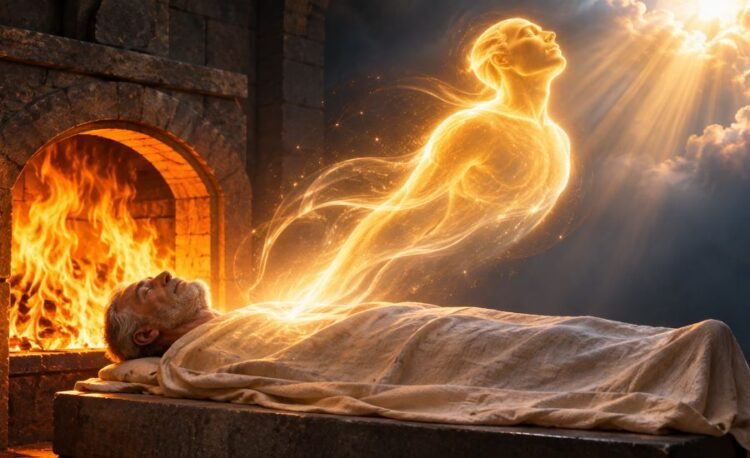
Is cremation a sin in the eyes of God? Does burning a person’s body prevent their soul from reaching heaven? And what does the Bible actually say about what happens to the body after death?
These questions have sparked debates among Christians for generations. While some churches strongly favor traditional burial, others accept cremation as a legitimate choice.
The Bible contains several passages about death, burial, fire, and resurrection. However, the answer may surprise those who believe Scripture explicitly condemns cremation.
To understand the issue, it is important to separate biblical teachings from religious traditions and popular misconceptions.
Does the Bible Say Cremation Is a Sin?
The Bible does not contain a direct, universal command stating that cremation is a sin.
Throughout Scripture, burial is the most commonly described practice for honoring the dead. Important biblical figures, including Abraham, Sarah, Isaac, Jacob, and Jesus Christ, were buried rather than cremated.
For this reason, many Christians regard burial as the traditional biblical approach.
However, describing burial as the preferred practice is not the same as explicitly prohibiting cremation.
There is no passage in the New Testament that directly declares that every person who chooses cremation has committed a sin.
This distinction is central to understanding why Christian denominations have developed different teachings about cremation.
The Surprising Biblical Story of King Saul
One of the most frequently discussed passages concerning cremation appears in 1 Samuel 31:11–13.
After King Saul and his sons died in battle against the Philistines, their bodies were publicly displayed.
When the people of Jabesh-gilead learned what had happened, they recovered the bodies.
The biblical account explains that they burned the bodies and subsequently buried the bones.
This is one of the clearest examples of the burning of human remains in the Bible.
Interestingly, the passage does not explicitly condemn the people who performed the act.
Instead, their actions are presented in the context of recovering and honoring the remains of their fallen king.
Some biblical scholars suggest the burning may have been intended to address the condition of the bodies, although the text does not explain the exact reason.
Others note that the survivors still buried the remaining bones, demonstrating respect for the dead.
The account shows that burning human remains occurred in biblical history, even though it was not the ordinary Israelite burial custom.
Why Were Most Biblical Figures Buried?
Burial occupies a significant place in biblical history.
In Genesis 23, Abraham purchases a burial site for his wife Sarah.
In Genesis 50, Joseph participates in the burial arrangements for his father Jacob.
The Gospels describe how Jesus was placed in a tomb after His crucifixion.
These examples helped shape the traditional Christian preference for burial.
For many believers, burial symbolizes respect for the human body and hope in the resurrection.
The body is not simply viewed as disposable material.
Christian theology traditionally regards the human person as a unity of body and soul, with the body possessing inherent dignity.
However, while burial carries powerful religious symbolism, the biblical examples do not automatically establish an explicit prohibition against every other method of handling human remains.
What Does the Bible Say About Turning to Dust?
One of the most familiar biblical passages about death appears in Genesis 3:19.
The verse teaches that human beings come from dust and eventually return to dust.
This passage is frequently mentioned during discussions about cremation.
Some Christians interpret it as support for natural burial, in which the body gradually decomposes.
Others point out that cremation also ultimately reduces the body to mineral remains.
From this perspective, both burial and cremation involve the physical body returning to the elements of the earth.
The verse itself does not specify a required funeral method.
Its primary message concerns human mortality rather than detailed instructions for burial.
Does Cremation Prevent Resurrection?
This is one of the most important questions surrounding cremation in Christianity.
Some believers worry that destroying the physical body through fire could interfere with the resurrection promised in Scripture.
However, mainstream Christian theology does not teach that God requires a perfectly preserved physical body to accomplish resurrection.
In 1 Corinthians 15, the apostle Paul discusses the resurrection of the dead and the transformation of the body.
He explains that the resurrected body will be different from the mortal body subject to decay.
The passage emphasizes transformation and the power of God rather than preservation of the body’s original physical condition.
This creates an important theological consideration.
Human bodies naturally decompose after death. Throughout history, people have also died in fires, shipwrecks, wars, and other circumstances in which their remains could not be recovered.
Christian belief in resurrection does not generally depend upon the continued physical integrity of a person’s remains.
Therefore, cremation is not considered an obstacle to God’s power to resurrect the dead by many Christian traditions.
What About the Bible’s Warnings About Fire?
Some people associate cremation with biblical passages that describe fire as a symbol of judgment or punishment.
One frequently discussed example appears in Amos 2:1.
In this passage, God condemns Moab for burning the bones of the king of Edom.
At first glance, this might appear to be a direct condemnation of cremation.
However, the context is different from an ordinary funeral.
The passage concerns a hostile act involving the desecration of another ruler’s remains.
Many biblical interpreters understand the condemnation as directed toward the dishonoring of the dead rather than a universal prohibition of cremation.
Similarly, other passages involving destructive fire must be interpreted within their historical and theological contexts.
Fire can symbolize judgment, purification, destruction, or divine presence in Scripture.
It does not always carry the same meaning.
Using every biblical reference to fire as evidence against cremation oversimplifies a complex religious question.
What Does the Catholic Church Teach About Cremation?
The Catholic Church traditionally prefers burial because it expresses respect for the body and belief in the resurrection.
However, Catholic teaching permits cremation under certain conditions.
In 1963, the Church formally clarified that cremation is not inherently contrary to Christianity when it is not chosen as a rejection of fundamental Christian beliefs.
This position was reaffirmed in later Church instructions.
The Catholic Church continues to emphasize that human remains should be treated with dignity.
When cremation is chosen, Catholic teaching generally requires the ashes to be placed in a sacred location, such as a cemetery or an approved place of interment.
Scattering ashes or dividing them among family members as ordinary keepsakes is generally not permitted under Catholic rules, although specific provisions exist for limited situations.
The Church therefore distinguishes between cremation itself and practices involving the treatment of cremated remains.
Its central concern is preserving respect for the deceased and maintaining the Christian understanding of death and resurrection.
Why Does the Orthodox Church Oppose Cremation?
Eastern Orthodox Christianity generally maintains a much stronger preference for traditional burial.
In many Orthodox churches, cremation is discouraged or rejected as inconsistent with the Church’s established funeral practices.
The Orthodox understanding emphasizes the holiness of the human body and the importance of burial within the Christian tradition.
The body is treated with reverence because it participated in the person’s earthly life, worship, and spiritual experience.
Traditional Orthodox funeral rites are closely connected to burial and the hope of bodily resurrection.
Consequently, choosing cremation may affect whether certain Orthodox funeral services are provided.
The precise pastoral response can vary by Orthodox jurisdiction and individual circumstances.
This position is rooted in longstanding Church tradition and theological interpretation rather than a single biblical verse explicitly banning cremation.
What Do Protestant Churches Believe?
Protestant denominations hold a range of views.
Many Protestant churches allow individuals and families to choose either burial or cremation.
They generally emphasize that salvation and resurrection do not depend on how the body is handled after death.
Some conservative Protestant communities strongly prefer burial because of biblical examples and the symbolism of resurrection.
Others regard cremation as a practical matter that should be decided according to personal conviction, family circumstances, and financial considerations.
There is no single Protestant position universally accepted by every denomination.
Is the Soul Affected by Cremation?
Another common fear is that cremation somehow harms or destroys the soul.
This belief is not supported by mainstream Christian teachings about the distinction between the physical body and the soul.
In Christian theology, death marks the end of earthly bodily life, but the ultimate destiny of the person is understood in relation to God.
The physical process used to handle human remains is not generally understood to determine whether a person receives salvation.
The New Testament places emphasis on faith, grace, judgment, and resurrection rather than the specific funeral method chosen by surviving relatives.
Different Christian traditions explain the relationship between the soul, death, and resurrection in different ways.
Nevertheless, cremation is not described in Scripture as a process that destroys the soul or automatically prevents someone from entering heaven.
Why Has Cremation Become More Common?
Cremation has become increasingly common in many parts of the world.
Several practical factors influence this trend.
Traditional funerals and burials can be expensive, particularly when they involve purchasing a burial plot, casket, and other services.
Cremation may provide families with a less expensive alternative.
Space limitations in urban cemeteries can also influence funeral arrangements.
Some people choose cremation because of environmental concerns, although both burial and cremation have environmental impacts that depend on the methods used.
Personal preferences, family traditions, and cultural attitudes also play important roles.
For religious families, however, the decision often involves more than practical considerations.
It can raise deeply personal questions about faith, respect, and the meaning of death.
What Matters Most According to Christian Teaching?
When examining the Bible as a whole, several themes consistently appear in its treatment of death.
Human life is presented as valuable.
The dead are generally to be treated with dignity.
Grief and mourning are recognized as meaningful human experiences.
And resurrection remains central to Christian hope.
These themes help explain why traditional burial has maintained such a significant place in Christian history.
At the same time, the Bible does not provide a comprehensive set of instructions covering every possible funeral practice.
Much of the disagreement surrounding cremation therefore comes from differences in theological interpretation, church tradition, and cultural practice.
For believers considering cremation, consulting the teachings of their own church may be important.
Final Thoughts: Is Cremation Really a Sin?
The claim that the Bible clearly and universally declares cremation sinful is not supported by an explicit biblical prohibition.
Scripture overwhelmingly presents burial as the traditional practice, and this history remains deeply meaningful to many Christians.
However, the Bible also records instances in which human remains were burned without directly condemning the act in every circumstance.
Different Christian denominations have developed distinct teachings about how these passages should be understood.
The Catholic Church permits cremation under established conditions, while Eastern Orthodox churches generally oppose the practice. Many Protestant denominations leave the decision to individual believers and families.
Perhaps the most important distinction is that choosing cremation does not automatically mean rejecting belief in God, the soul, or the resurrection.
For Christians, the deeper questions concern reverence for human life, respect for the dead, and faith in what happens beyond death.
Ultimately, burial and cremation are physical processes, while the Christian promise of resurrection rests upon the power of God.
