
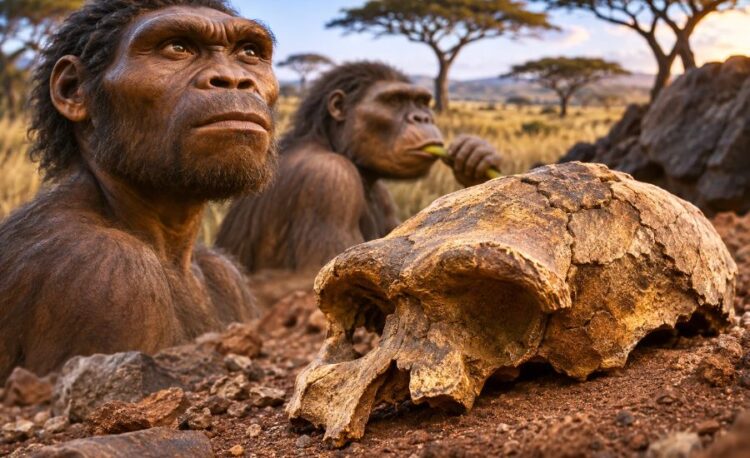
A remarkable fossil discovery in South Africa is reshaping scientists’ understanding of human evolution. Researchers have identified new evidence showing that Homo erectus, one of humanity’s most important ancient relatives, was living in southern Africa approximately 2 million years ago—around 200,000 years earlier than the age traditionally associated with some of the earliest well-known adult fossils of the species.
The discovery comes from the Drimolen Main Quarry, a prehistoric site located in South Africa’s famous Cradle of Humankind.
An international research team identified and described 18 hominin fossils, including a rare adult skull fragment attributed to Homo erectus.
The findings, published in the scientific journal Annals of Human Biology in September 2026, strengthen previous evidence that this ancient human species was already present in southern Africa around 2 million years ago.
But the discovery reveals something even more fascinating: two different human relatives were living in the same environment, following dramatically different evolutionary paths.
A Discovery That Challenges the Timeline of Human Evolution
For decades, scientists have attempted to reconstruct the history of human evolution using fossilized bones, ancient tools, geological formations, and archaeological evidence.
One of the most important species in this history is Homo erectus.
The species is widely recognized as an early human relative with body proportions that increasingly resembled those of modern humans.
Homo erectus is particularly important because it represents a major transition toward larger brains, more humanlike walking and running abilities, and adaptation to a variety of environments.
For many years, some of the earliest well-known adult Homo erectus fossils were associated with sites such as Dmanisi in Georgia, dating to approximately 1.8 million years ago.
However, discoveries from South Africa have provided evidence that Homo erectus was present even earlier.
The newly analyzed adult fossil strengthens that interpretation.
Researchers identified a skull fragment designated DNH 127, which provides additional evidence of adult Homo erectus individuals living approximately 2 million years ago.
Importantly, the fossil does not establish the exact moment the species first evolved. Instead, it reinforces evidence that Homo erectus existed by that time.
The 2-Million-Year-Old Fossil Found in South Africa
The discovery comes from Drimolen Main Quarry, an archaeological site known for its exceptional collection of ancient human fossils.
Located within South Africa’s Cradle of Humankind, the area has provided scientists with valuable evidence about early human evolution.
The quarry was discovered in 1992 and excavated through 2019.
Over the years, researchers recovered numerous fossilized remains, but many had not yet received comprehensive scientific descriptions.
An international team led by Dr. Jesse Martin of La Trobe University in Australia examined 18 previously undescribed hominin fossils.
The collection included remains attributed to Homo erectus and another ancient human relative known as Paranthropus robustus.
One of the most significant specimens was DNH 127, an adult Homo erectus skull fragment.
This discovery was particularly important because earlier evidence from the same site included a juvenile Homo erectus specimen designated DNH 134.
That fossil belonged to a young child estimated to have been between two and four years old.
The adult skull fragment provides another opportunity to study the species’ anatomy and strengthens the identification of Homo erectus at the site.
Why the Adult Fossil Is So Important
Scientists often face major challenges when identifying ancient human species from incomplete skeletal remains.
Children’s skulls and bones can look considerably different from those of adults.
During growth, the human skull changes in shape, size, proportions, and structural development.
These changes can complicate attempts to determine which ancient species a juvenile fossil belonged to.
The earlier Drimolen specimen, DNH 134, provided important evidence of early Homo erectus.
However, because it came from a young child, researchers had limited information about what adult members of the same population might have looked like.
The newly described adult fossil helps address this problem.
By examining an adult skull fragment from the same ancient environment, researchers gained additional anatomical evidence supporting the presence of Homo erectus.
The discovery strengthens the case that the species existed in southern Africa approximately 2 million years ago.
It also highlights how even a relatively small fossil fragment can provide valuable information about human evolutionary history.
Who Were Homo Erectus?
Homo erectus was one of the most successful and long-lasting members of the human evolutionary lineage.
The name translates approximately to “upright human,” reflecting the species’ ability to walk on two legs.
Although earlier human ancestors were already capable of upright walking, Homo erectus displayed body proportions that more closely resembled those of modern humans.
Compared with some earlier hominins, Homo erectus generally had longer legs, relatively shorter arms, and a body structure well suited to traveling on the ground.
These physical characteristics likely helped the species move efficiently across different landscapes.
Homo erectus also possessed a larger brain than many earlier human relatives, although brain size varied significantly among individuals and populations.
The species eventually spread across large portions of Africa and Asia.
Fossils associated with Homo erectus have been discovered in several regions, including East Africa, southern Africa, Georgia, China, and Indonesia.
Its remarkable geographic distribution and long evolutionary history make Homo erectus one of the most important species for understanding how early humans adapted and spread into new environments.
Two Different Human Relatives Shared the Same Landscape
One of the most fascinating aspects of the new research is that Homo erectus was not living alone.
Another ancient human relative, Paranthropus robustus, inhabited the same South African environment.
Although both belonged to the broader human evolutionary family, they followed different evolutionary strategies.
Homo erectus developed characteristics associated with a larger brain, smaller molar teeth, and potentially greater dietary flexibility.
Paranthropus robustus, by contrast, evolved powerful chewing structures and unusually large teeth.
These adaptations likely helped it process mechanically challenging foods.
The newly described fossils provide evidence that these two lineages coexisted in the Drimolen region approximately 2 million years ago.
This is significant because human evolution was not a simple sequence in which one species disappeared immediately before another emerged.
Instead, multiple human relatives sometimes lived during the same periods, sharing landscapes and potentially competing for resources.
The Surprising Difference Between Their Teeth
Researchers found evidence that Paranthropus robustus underwent noticeable anatomical changes over approximately 200,000 years.
By comparing fossils from Drimolen, dating to around 2 million years ago, with specimens from the nearby Swartkrans site, dating to approximately 1.8 million years ago, scientists identified differences in chewing anatomy.
The later Paranthropus populations possessed even larger teeth and more developed chewing structures.
These changes suggest that the species continued adapting to its environment over time.
Large molars and powerful chewing muscles may have helped these ancient relatives process tough or hard foods.
Meanwhile, Homo erectus appears to have followed a different evolutionary path.
Its smaller molars and relatively larger brain may reflect changes in diet, food processing, and behavior.
Researchers have suggested that increased consumption of animal foods may have contributed to some of these differences, although the precise dietary history remains a subject of scientific investigation.
The contrast reveals how two closely related evolutionary lineages could adapt differently to similar environmental pressures.
The Unexpected Survival Advantage
Perhaps the most surprising aspect of the Drimolen findings concerns the relative abundance of the two ancient human species.
According to the researchers, Paranthropus robustus fossils were significantly more common than Homo erectus remains at the site.
The fossil evidence suggests that Paranthropus robustus outnumbered Homo erectus by more than ten to one in the Drimolen assemblage.
This does not necessarily mean the living population had exactly the same ratio, because fossil preservation and discovery can be influenced by numerous factors.
Nevertheless, the difference provides an intriguing glimpse into the ancient environment.
At that particular location and time, Paranthropus robustus appears to have been far more common in the fossil record.
Yet its evolutionary lineage eventually disappeared.
Homo erectus, meanwhile, persisted for an exceptionally long period and spread widely across Africa and Asia.
Its evolutionary lineage is widely considered important to the ancestry of later humans, although the exact relationships among early Homo populations remain debated.
This contrast reminds scientists that evolutionary success cannot always be predicted by how numerous a species appears at one moment in history.
What Was Africa Like 2 Million Years Ago?
The world inhabited by Homo erectus was dramatically different from the one we know today.
Around 2 million years ago, Africa experienced significant environmental and climatic changes.
Landscapes included mixtures of grasslands, woodlands, and other habitats.
Changes in temperature, rainfall, vegetation, and food availability created new challenges for animals and early human populations.
Different hominin species developed different adaptations to these conditions.
Some specialized in processing particular types of food, while others may have benefited from more flexible diets and behaviors.
Homo erectus eventually became associated with broad geographic expansion and the ability to occupy a variety of environments.
The Drimolen fossils provide another window into this period of evolutionary experimentation.
They show that multiple human relatives were living in the same region while developing different anatomical characteristics.
Understanding how these populations responded to environmental changes may help explain why certain evolutionary lineages persisted while others disappeared.
Does This Discovery Mean Humans Are 200,000 Years Older?
Not exactly.
The discovery concerns Homo erectus, not the earliest appearance of modern humans.
Modern humans belong to the species Homo sapiens.
The earliest widely accepted Homo sapiens fossils date to approximately 300,000 years ago in Africa.
Homo erectus lived much earlier and represents a different species within the broader human evolutionary lineage.
The new research reinforces evidence that Homo erectus was present approximately 2 million years ago, compared with some previously recognized adult fossils dating to about 1.8 million years ago.
It does not mean that modern humans suddenly became 200,000 years older.
It also does not prove that Homo erectus originated specifically at Drimolen.
The precise geographic origin and evolutionary relationships of early Homo erectus populations remain subjects of ongoing research.
Why Fossil Discoveries Can Change Scientific History
The fossil record is incomplete.
Only a small fraction of organisms that lived millions of years ago became fossilized, and an even smaller fraction of those fossils have been discovered.
As a result, scientific timelines often change when researchers uncover new evidence.
A species may have existed long before its oldest currently known fossil.
Discovering an older specimen can therefore establish that the species was already present at an earlier date.
Scientists use several methods to determine fossil ages, including analysis of surrounding geological layers, magnetic signals preserved in sediments, and radiometric dating of suitable materials.
They also compare anatomical features across specimens to determine how fossils may be related.
In the case of the Drimolen discovery, the adult Homo erectus fossil provides additional evidence for an age already suggested by earlier findings from the site.
This distinction matters.
The research strengthens an existing interpretation rather than independently discovering that Homo erectus was 200,000 years older for the first time.
What the Discovery Tells Us About Human Evolution
The findings highlight three important aspects of human evolutionary history.
First, Homo erectus was already present in southern Africa approximately 2 million years ago, earlier than the age of some historically important adult fossils from other regions.
Second, multiple human relatives shared the same landscapes and developed different adaptations.
Third, evolutionary change could occur over relatively short geological periods.
The differences observed between Paranthropus robustus populations separated by approximately 200,000 years provide valuable evidence of gradual anatomical change.
Rather than relying only on widely separated fossils, scientists can compare populations that lived relatively close together in both time and geography.
This offers a more detailed picture of how evolutionary changes accumulated across generations.
It also challenges the popular misconception that human evolution followed one straight, predictable path.
The history of our evolutionary family resembles a branching tree, with multiple species emerging, adapting, coexisting, and eventually disappearing.
Could More Discoveries Change the Human Family Tree Again?
Almost certainly.
New archaeological and fossil discoveries continue to reshape scientific understanding of early human history.
Some discoveries extend the known timeline of particular species.
Others reveal unexpected anatomical features or provide evidence that different human relatives overlapped in time.
Advances in imaging, geological dating, and molecular analysis also allow scientists to revisit fossils discovered decades earlier.
Specimens that once seemed too incomplete to analyze may provide new information when examined using modern technology.
The Drimolen research demonstrates why museum collections and previously excavated fossils remain scientifically valuable.
Not every important discovery requires finding a completely new excavation site.
Sometimes, crucial evidence has already been recovered and is waiting to be carefully studied.
Final Thoughts
The identification of a 2-million-year-old adult Homo erectus fossil in South Africa provides important new evidence about one of humanity’s most significant ancient relatives.
The findings strengthen the argument that Homo erectus was already present in southern Africa approximately 200,000 years earlier than the age traditionally associated with some of its earliest known adult fossils.
They also reveal important anatomical changes in Paranthropus robustus, a different human relative that occupied the same prehistoric landscape.
Perhaps the most remarkable lesson is that the evolutionary lineage associated with our later ancestors was not necessarily the most abundant or dominant group in its environment 2 million years ago.
The discovery reinforces a fundamental principle of evolutionary science: the path leading to modern humans was neither simple nor inevitable.
Every newly examined fossil adds another piece to a complex history stretching across millions of years.
And as researchers continue exploring ancient sites and reexamining existing collections, the story of human origins may change again.
