
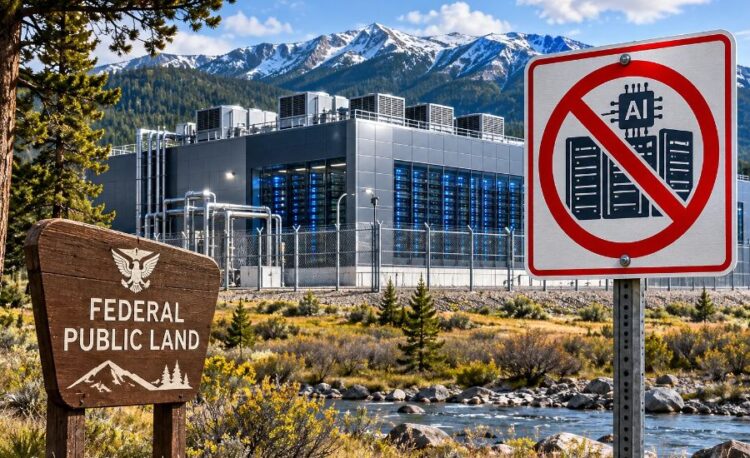
A controversial proposal introduced in the United States Congress could dramatically change where artificial intelligence infrastructure is allowed to operate. The legislation seeks to prohibit AI data centers on federally owned land, require existing facilities to shut down and begin removal, and ensure that affected sites undergo environmental remediation and restoration.
The proposal, known as the No AI Data Centers on Federal Lands Act, was introduced on July 23, 2026, by Democratic Representative Rashida Tlaib of Michigan and five co-sponsors.
Designated H.R. 9939, the bill reflects growing concerns about the environmental consequences of rapidly expanding artificial intelligence infrastructure, including electricity consumption, water demand, industrial development, and the use of public land.
If enacted, it would establish a sweeping federal restriction on AI data centers and the infrastructure supporting them.
However, the proposal has not become law. As of November 21, 2026, H.R. 9939 remains at the introduced stage, having been referred to the House Committee on Natural Resources. GovInfo+1
What Exactly Would the New Legislation Do?
The proposed legislation would prevent the construction and operation of qualifying artificial intelligence data centers on federally owned or managed land.
Its restrictions would extend beyond server buildings themselves.
The proposal also covers associated infrastructure, including electricity transmission lines, power substations, natural gas facilities, water pipelines, and cooling systems built to support AI data centers.
One of its most significant provisions concerns facilities that already exist.
Rather than allowing existing operations to continue indefinitely, the bill would require federal agencies to cease covered operations or construction within 30 days of enactment.
Agencies would also have to begin removing the facilities or direct their lessees to do so.
Removal could involve dismantling or demolishing infrastructure, subject to applicable environmental requirements.
The legislation does not specify that every facility must be completely removed within those 30 days. Instead, it establishes that deadline for stopping operations or construction and beginning removal.
Why Are Lawmakers Targeting AI Data Centers?
Artificial intelligence has created enormous demand for computing infrastructure.
AI systems rely on specialized processors housed in facilities capable of performing large numbers of calculations simultaneously.
These operations require substantial electrical power, sophisticated cooling equipment, reliable communications networks, and extensive physical infrastructure.
As investment in artificial intelligence increases, technology companies and infrastructure developers are searching for locations capable of supporting large-scale data centers.
Federal public lands have become part of the debate because they include areas potentially suitable for major energy and industrial projects.
Critics argue that placing large AI facilities on these lands could create long-term environmental consequences while limiting access to land intended for public benefit.
Supporters of additional restrictions believe public lands should be protected from industrial development that may threaten ecosystems, wildlife habitats, water resources, and recreational opportunities.
Meanwhile, advocates for continued infrastructure development argue that data centers are essential to technological innovation, economic competitiveness, and national security.
The dispute highlights an increasingly difficult question: How much environmental disruption should society accept to support the expansion of artificial intelligence?
The Hidden Environmental Costs of Artificial Intelligence
Although artificial intelligence is often discussed as a digital technology, its physical infrastructure has measurable environmental impacts.
1. Electricity consumption
AI data centers can require substantial amounts of electricity.
Large facilities may consume power on a scale comparable to major industrial operations.
As demand increases, utilities may need to construct additional transmission lines, expand substations, or develop new generating capacity.
Depending on how electricity is produced, rising demand can increase greenhouse gas emissions and other environmental pressures.
2. Water consumption
Many data centers rely on cooling systems to prevent servers and processors from overheating.
Some cooling technologies use significant amounts of water, especially in hot climates.
This can create concerns in communities already experiencing drought or water shortages.
Actual water consumption varies considerably according to climate, technology, facility design, and operating conditions.
3. Land disturbance
Constructing large data centers may require clearing vegetation, grading land, building access roads, and installing electrical and water infrastructure.
These activities can fragment wildlife habitats and alter local landscapes.
Environmental impacts can be especially sensitive in areas containing protected species, important watersheds, or fragile ecosystems.
4. Additional energy infrastructure
A large data center may require more than a server building.
Power plants, substations, transmission corridors, backup generators, and cooling infrastructure can significantly increase a project’s physical footprint.
H.R. 9939 explicitly addresses several of these associated facilities rather than focusing only on the buildings containing computers.
Existing AI Facilities Could Face Removal
One of the proposal’s most controversial features is its treatment of facilities already operating or under construction on federal land.
Under the proposed legislation, federal agencies responsible for covered AI data centers would have to stop operations or construction within 30 days after enactment.
They would also be required to begin removal or order the relevant lessee to remove the facilities.
The bill includes provisions requiring site cleanup and restoration in accordance with applicable federal environmental law.
This means that simply shutting down servers would not necessarily satisfy the proposal.
Removing a covered facility could involve dismantling electrical equipment, eliminating associated structures, addressing contamination where legally required, and restoring disturbed land.
However, the actual scope of environmental remediation would depend on the site and applicable legal requirements.
This provision could create major financial and logistical consequences for any covered projects.
It also raises questions about federal leases, infrastructure investments, contractual obligations, and implementation costs.
Would the Ban Apply to Every AI Data Center in America?
No.
The proposed restriction concerns qualifying AI data centers located on federal land.
It would not establish a nationwide prohibition on AI data centers operating on privately owned property.
The legislation defines federal land broadly, including land owned or managed by the United States and property under the jurisdiction of the Department of Defense.
It excludes land held in trust by the United States for the benefit of Native American tribes or tribal members.
The bill also establishes a technical definition of an AI data center.
That definition includes facilities used to develop or operate artificial intelligence models at scale, as well as certain high-powered computing facilities meeting specified electricity and cooling criteria.
This distinction is important because not every ordinary server room or small computing facility would necessarily qualify.
Another Proposal Is Adding Pressure in Congress
H.R. 9939 is not the only attempt to restrict data center development on federal property.
On November 11, 2026, Representative Maxine Dexter of Oregon introduced a separate measure, H.R. 11002, titled the Protecting Our Public Lands from Data Centers Act of 2026.
This proposal would prohibit new data center construction on National Forest System land and land managed by the Department of the Interior, subject to specified exclusions.
It would also require certain federal land transfers to include provisions allowing the land to revert to federal ownership if subsequently used for a data center without congressional authorization.
Unlike H.R. 9939, the newer bill does not contain the same broad requirement to remove existing facilities.
The distinction demonstrates that lawmakers are exploring different regulatory approaches, ranging from restrictions on future construction to more comprehensive prohibitions.
Neither proposal should be confused with an enacted nationwide ban. GovInfo+1
Could This Threaten America’s Artificial Intelligence Industry?
The potential consequences would depend heavily on how the legislation is implemented and how many projects rely on federal land.
Artificial intelligence has become a major area of investment for technology companies, utilities, infrastructure developers, and financial institutions.
Large-scale computing facilities support activities ranging from medical research and scientific modeling to automation, digital communications, and advanced software development.
Restricting development on federal property could force some companies to reconsider planned locations.
Projects might shift toward privately owned industrial sites or other areas permitted under state and local laws.
Such changes could increase costs or delay certain developments.
However, the proposal would not prevent the AI industry from building data centers throughout the United States.
Most importantly, claims that the bill would shut down the entire American AI industry are not supported by its text.
The restrictions would apply to specific facilities and infrastructure located on covered federal property.
Why Public Lands Have Become a Political Flashpoint
Public lands occupy an important position in American environmental and economic policy.
They support recreation, wildlife conservation, grazing, resource development, energy production, and other uses.
Decisions about how these lands should be managed frequently involve competing priorities.
Supporters of stronger environmental protections argue that large industrial projects can create lasting changes to landscapes and ecosystems.
They question whether public property should be used to support private technology infrastructure, particularly when local communities may face additional water or electricity demands.
Opponents of broad restrictions may argue that carefully regulated development can create economic opportunities and strengthen critical infrastructure.
They also contend that some projects could be designed to minimize environmental damage through responsible site selection, water-efficient cooling, and cleaner energy sources.
The central disagreement is not simply whether artificial intelligence should continue expanding.
It concerns where that expansion should take place, who bears its environmental costs, and who receives its economic benefits.
What Would Happen if the Bill Became Law?
For H.R. 9939 to become federal law, it would need to pass both chambers of Congress and receive presidential approval, unless Congress enacted it over a presidential veto.
Until then, it remains a legislative proposal.
If enacted in its current form, the measure would prohibit qualifying AI data centers and associated infrastructure from operating or being constructed on covered federal land.
Federal agencies would face a 30-day deadline to cease relevant activities and begin facility removal.
Environmental remediation and restoration would follow applicable legal standards.
There would likely be substantial questions surrounding enforcement, funding, contracts, and the practical management of affected sites.
The proposal itself does not establish how many facilities would be affected or provide a comprehensive estimate of implementation costs.
Those details would require further analysis.
The Bigger Question: Should Public Land Be Used for Artificial Intelligence?
The rapid growth of AI has forced governments to confront issues that extend beyond software development.
Advanced technology depends on physical resources.
Behind every major AI application are processors, servers, electrical infrastructure, cooling systems, buildings, and supply chains.
These systems can provide substantial benefits, including improvements in scientific research, healthcare, engineering, and productivity.
But they can also impose environmental and infrastructure costs.
The debate surrounding H.R. 9939 reflects a broader question about the responsibilities of governments and technology companies.
Should publicly owned land be available for energy-intensive computing projects?
Or should those projects be directed toward private industrial areas where their environmental and infrastructure requirements can be more closely managed?
There are legitimate arguments on both sides, and the appropriate balance may vary according to location, environmental sensitivity, economic benefits, and the availability of alternative sites.
Final Thoughts
The No AI Data Centers on Federal Lands Act represents one of the more aggressive proposals aimed at limiting the physical expansion of artificial intelligence infrastructure on federal property.
By seeking to prohibit qualifying AI data centers, require the removal of existing facilities, and address restoration of affected sites, the legislation would create substantial changes if enacted.
It also illustrates how environmental concerns are becoming an increasingly important part of national debates about artificial intelligence.
The key fact is that Congress is considering restrictions on AI data centers on federal lands—not that those facilities have already been banned.
Whether the proposal advances remains uncertain.
But the issue it raises is unlikely to disappear: as artificial intelligence continues expanding, policymakers will face growing pressure to determine how its physical infrastructure should coexist with environmental protection, energy affordability, and the public interest.
