
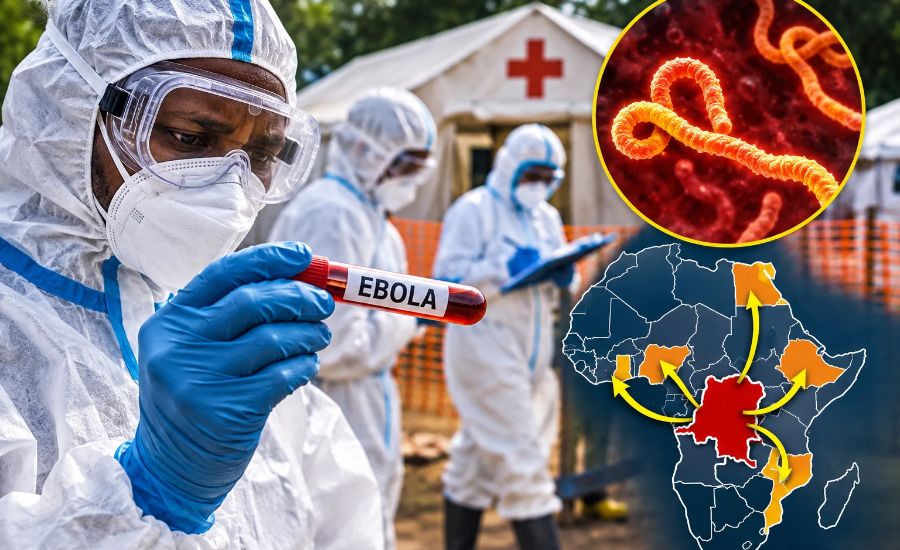

A deadly Ebola outbreak that began in the Democratic Republic of the Congo has reached four additional countries, raising international concerns as infections and deaths continue to climb. The World Health Organization has confirmed more than 11,600 cases and 5,600 deaths in Congo alone, while health authorities race to prevent further international transmission.
A rapidly expanding Ebola outbreak in Central Africa has become one of the most serious infectious disease emergencies of 2026, with confirmed cases reported in five countries.
The outbreak, first declared in May 2026 in the Democratic Republic of the Congo (DRC), is caused by Bundibugyo virus, a relatively rare member of the Ebola virus group.
Unlike the more familiar Ebola virus responsible for the devastating West African epidemic of 2014–2016, Bundibugyo virus currently has no specifically approved vaccine or antiviral treatment.
The World Health Organization (WHO) confirmed on November 20, 2026, that transmission remains widespread in the DRC, even as other affected countries make progress in containing infections.
Health officials are particularly concerned about the high number of deaths occurring outside treatment centers and the difficulty of reaching affected communities.
How Serious Is the Ebola Outbreak?
According to the WHO’s November 20 situation report, the Democratic Republic of the Congo had recorded the following figures as of November 17, 2026:
- 11,613 confirmed Ebola cases
- 5,678 reported deaths
- 48.9% case fatality ratio
- 68 affected health zones
- 8 provinces reporting infections
- 48 health zones with recent active transmission
These figures make the outbreak the largest Ebola epidemic ever documented in the Democratic Republic of the Congo.
The provinces of Ituri and North Kivu remain particularly affected.
Despite expanded emergency operations, the virus continues to spread within several communities.
On November 18, WHO determined that the outbreak still constituted a Public Health Emergency of International Concern, reflecting the seriousness of the situation and the continuing threat of international spread.
Which Four Other Countries Have Reported Ebola Cases?
Although the outbreak originated in the DRC, infections have also been confirmed in Uganda, Kenya, Nigeria, and France.
However, the situation differs significantly among these countries.
1. Uganda
Uganda was among the first countries affected by cross-border transmission.
Health officials identified infections linked to the outbreak in neighboring Congo.
Uganda reported 20 confirmed cases, including infections resulting from local transmission following imported cases.
After intensive contact tracing, patient isolation, and infection prevention measures, the outbreak was declared over in August 2026.
The country continues to maintain surveillance because of its proximity to affected regions of the DRC.
2. Kenya
Kenya reported its first confirmed infection in October 2026.
The virus subsequently spread to additional people associated with the original imported case.
By November 17, Kenya had recorded nine confirmed cases, including two deaths.
Eight secondary infections were linked to a single cluster involving family members and healthcare workers.
Importantly, all surviving hospitalized patients had recovered and been discharged by November 11.
No new confirmed cases had been reported since October 19.
Kenya is maintaining heightened surveillance while completing the observation period required before declaring its outbreak over.
3. Nigeria
Nigeria confirmed an imported Bundibugyo Ebola case in Abuja on October 20, 2026.
The case triggered an emergency public health response involving contact tracing, laboratory testing, and surveillance.
Health authorities identified 62 contacts requiring follow-up.
By mid-November, all identified contacts had completed their monitoring period.
No secondary infections had been confirmed in Nigeria.
The patient was medically evacuated to Switzerland, where treatment was completed and recovery confirmed.
Nigeria continues to monitor the situation because imported infections can create opportunities for further transmission.
4. France
France confirmed an imported Ebola infection in June 2026 involving a healthcare professional who had traveled from Congo.
The case demonstrated how international travel can transport infectious diseases beyond the regions where outbreaks originate.
However, French authorities prevented further transmission.
France’s outbreak was subsequently considered controlled, with no evidence of sustained community spread.
The distinction is important: Ebola cases have been identified in five countries, but the virus is not currently spreading through communities in all five.
Two Additional European Countries Treated Evacuated Patients
The international situation has also involved Switzerland and the United Kingdom.
Both countries received patients who were medically evacuated for specialist care.
Switzerland treated the Ebola patient originally diagnosed in Nigeria, while the United Kingdom received a healthcare worker evacuated from Congo.
Both patients recovered and were discharged from hospital in November.
These medical evacuations should not be confused with independent community outbreaks.
There was no reported sustained local transmission associated with these cases.
What Is Bundibugyo Ebola Virus?
Bundibugyo virus is one of the viruses capable of causing Ebola disease, a severe infection that can damage multiple organs and disrupt the body’s normal immune response.
It was first identified during an outbreak in Uganda in 2007.
The virus belongs to the filovirus family and can cause a disease clinically similar to Ebola caused by other related viruses.
The infection can progress rapidly and, in severe cases, lead to shock, organ failure, and death.
Historically, outbreaks associated with Bundibugyo virus have recorded substantial fatality rates.
The current outbreak’s reported case fatality ratio of nearly 49% illustrates its severity.
However, mortality rates can vary depending on the outbreak, the availability of healthcare, the timing of diagnosis, and access to supportive treatment.
How Does Ebola Spread From Person to Person?
Ebola is not normally transmitted through casual airborne exposure in the way that measles or influenza can spread.
Instead, infection occurs through direct contact with infected blood or other bodily fluids.
Transmission can happen when infectious material enters the body through broken skin or mucous membranes.
Potential sources of exposure include blood, vomit, diarrhea, saliva, and other bodily fluids from infected people.
Objects contaminated with infectious fluids can also pose a risk.
Healthcare settings can become particularly dangerous when appropriate protective equipment and infection prevention procedures are unavailable.
Traditional burial practices involving direct contact with the body of a deceased person can also contribute to transmission.
Importantly, people infected with Ebola are not considered contagious before symptoms develop.
The incubation period generally ranges from two to 21 days.
This delay can make contact tracing challenging, especially when infected individuals have traveled between communities or countries.
Early Symptoms of Ebola Everyone Should Recognize
Ebola symptoms can initially resemble those of several common infections.
The first signs may include:
- Sudden fever
- Severe headache
- Muscle and joint pain
- Extreme fatigue
- Sore throat
- General weakness
As the illness progresses, patients may experience vomiting, diarrhea, abdominal pain, dehydration, and impaired organ function.
Some patients develop unexplained bleeding, although bleeding does not occur in every case.
Because the early symptoms are nonspecific, laboratory testing is essential for confirming infection.
Anyone who develops compatible symptoms after possible exposure in an affected area should seek urgent medical advice and inform healthcare providers about their travel or contact history before arriving at a healthcare facility.
Early recognition can help patients receive appropriate care while protecting others from infection.
Why Is This Ebola Outbreak So Difficult to Control?
Several factors have complicated efforts to contain the outbreak in the Democratic Republic of the Congo.
One of the greatest challenges is insecurity in the country’s eastern provinces.
Armed conflict, displacement, and restricted access to certain communities can prevent healthcare workers from reaching infected patients.
Health facilities may also lack sufficient equipment, trained personnel, or reliable transportation.
Another concern is the large number of people dying outside designated treatment centers.
According to the WHO, 452 of the 720 deaths reported during the three weeks ending November 17 occurred in communities rather than treatment facilities.
This raises concerns about undetected infections and ongoing transmission.
When patients do not receive timely diagnosis and isolation, relatives and caregivers may unknowingly be exposed.
Authorities are expanding laboratory testing, surveillance, contact tracing, and community education to address these challenges.
Is There a Vaccine Against This Type of Ebola?
Vaccination has become an important tool against some forms of Ebola disease.
However, vaccines developed for Ebola caused by Zaire ebolavirus are not established as effective against Bundibugyo virus.
As of November 2026, no vaccine is specifically approved to prevent Bundibugyo virus disease.
Researchers are evaluating experimental vaccine candidates, and international health organizations are supporting efforts to accelerate vaccine development.
The absence of an approved vaccine makes traditional outbreak-control methods especially important.
These include identifying infections quickly, isolating patients, monitoring exposed contacts, and implementing strict infection prevention measures.
Can Ebola Be Treated?
Although there is no approved antiviral treatment specifically targeting Bundibugyo virus disease, medical care can substantially improve a patient’s chances of survival.
Treatment focuses on supporting the body while it fights the infection.
Patients may require intravenous fluids, electrolyte replacement, oxygen, blood pressure support, and treatment for complications.
Early medical intervention is particularly important because severe diarrhea and vomiting can cause dangerous dehydration.
Researchers are also investigating experimental treatments that may eventually improve outcomes for patients infected with Bundibugyo virus.
However, no herbal remedy, supplement, or home treatment has been proven to cure Ebola.
Suspected infections require immediate professional medical attention.
Could Ebola Spread to Europe or the United States?
The international cases have raised concerns about whether the outbreak could eventually reach additional countries.
International travel creates opportunities for infected individuals to cross borders before developing symptoms.
However, an imported case does not automatically lead to a larger outbreak.
Countries with strong healthcare systems, rapid laboratory testing, effective isolation procedures, and contact tracing capabilities are generally better equipped to prevent sustained transmission.
WHO currently considers the risk very high in the Democratic Republic of the Congo, while other countries face different levels of risk depending on their proximity, travel connections, and public health capacity.
For most countries without significant exposure to the affected regions, the assessed risk remains low.
Nevertheless, public health authorities continue to emphasize the importance of preparedness.
What Happens Next?
WHO and national health authorities are continuing to strengthen emergency response operations across affected areas.
Their priorities include expanding access to treatment, improving laboratory testing, protecting healthcare workers, and increasing community awareness.
Cross-border surveillance remains essential because population movement can connect affected and unaffected communities.
Kenya and Nigeria are progressing toward declaring their outbreaks over, provided no additional infections are detected.
Meanwhile, the Democratic Republic of the Congo remains the center of sustained transmission.
The speed at which the outbreak can be brought under control will depend heavily on security conditions, healthcare access, community cooperation, and sustained international support.
Final Thoughts
The 2026 Ebola outbreak has developed into a serious international public health emergency, with more than 11,600 confirmed cases and over 5,600 deaths reported in the Democratic Republic of the Congo as of November 17.
Although infections have reached four other countries, the situation is not the same everywhere.
Uganda and France have controlled their outbreaks, while Kenya and Nigeria are monitoring for further infections after recent cases.
The greatest ongoing danger remains in Congo, where widespread transmission and limited access to healthcare continue to threaten communities.
The outbreak highlights a critical lesson from previous Ebola emergencies: early detection, transparent reporting, effective medical care, and coordinated international action can determine whether an outbreak remains contained or escalates into a much larger crisis.
With thousands of lives already lost, the question now is whether international health authorities can contain the outbreak before the virus reaches additional countries.



Leave a Reply
You must be logged in to post a comment.