
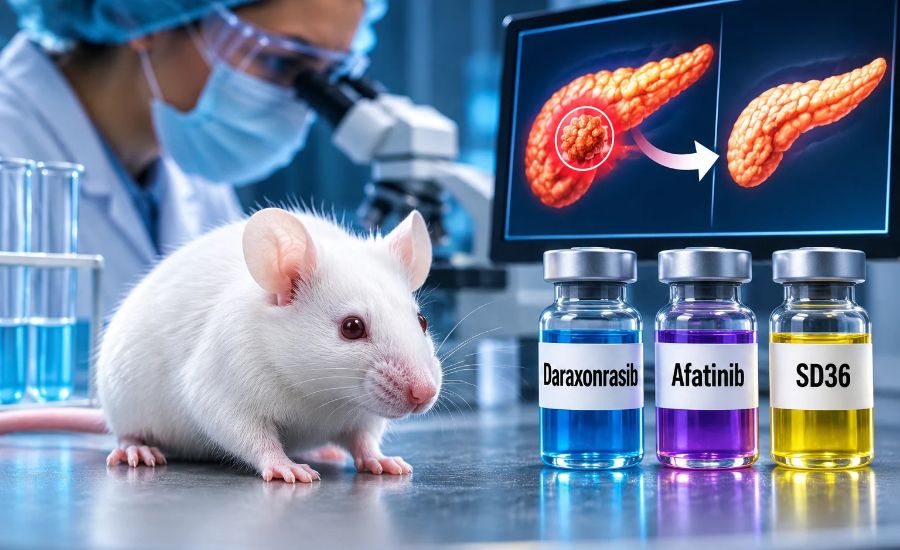

Scientists have achieved a remarkable breakthrough in pancreatic cancer research, developing a three-drug treatment that eliminated tumors in experimental mice and prevented the cancer from returning during prolonged observation. Even more surprisingly, the treatment produced no significant toxicity in the animal models studied, raising hopes for a new generation of cancer therapies.
Pancreatic cancer has long been considered one of the most difficult cancers to treat. Its aggressive nature, tendency to spread, and resistance to existing therapies have made it a particularly challenging disease for oncologists.
But researchers at Spain’s National Cancer Research Centre (CNIO) have developed an experimental treatment that could represent an important step toward overcoming these obstacles.
Led by renowned cancer researcher Mariano Barbacid, the scientific team designed a combination therapy targeting three different components of a molecular pathway responsible for driving pancreatic tumor growth.
The results, published in the prestigious journal Proceedings of the National Academy of Sciences (PNAS) in June 2026, demonstrated substantial and lasting tumor regression across three experimental mouse models.
In some experiments, tumors disappeared completely and did not return during extended monitoring.
Most importantly, the researchers reported that the treatment was well tolerated, without significant toxic effects in the mice studied.
Although the therapy has not yet been proven safe or effective in humans, the discovery offers a promising new direction in the battle against one of the world’s deadliest cancers.
Why Pancreatic Cancer Is So Difficult to Treat
Pancreatic cancer is especially dangerous because it frequently develops without obvious symptoms during its early stages.
The pancreas is a small organ located behind the stomach. It plays an essential role in digestion and blood sugar regulation.
When cancer develops in this organ, tumors can grow and spread before patients experience noticeable warning signs.
Common symptoms may include unexplained weight loss, abdominal or back pain, jaundice, digestive problems, and persistent fatigue.
Unfortunately, these symptoms can resemble those of less serious conditions, contributing to delays in diagnosis.
Pancreatic ductal adenocarcinoma, or PDAC, accounts for approximately 90% of pancreatic cancer cases.
This particular form is notorious for its aggressive behavior and resistance to treatment.
Unlike some other cancers, pancreatic tumors often develop a dense network of surrounding tissue that makes it difficult for medications and immune cells to reach malignant cells effectively.
Additionally, pancreatic cancer cells can rapidly adapt to therapies designed to stop their growth.
As a result, even treatments that initially shrink tumors may eventually lose their effectiveness.
This ability to develop drug resistance has been one of the greatest obstacles facing pancreatic cancer researchers.
The Discovery: A Three-Drug Combination That Attacks Cancer Differently
Instead of relying on a single medication, the Spanish research team developed a strategy involving three compounds that interfere with different components of the cancer-driving signaling system.
The combination includes:
- Daraxonrasib: A targeted medication designed to inhibit proteins in the RAS family, including the cancer-driving KRAS pathway.
- Afatinib: A medication used in certain forms of lung cancer that blocks signaling through specific growth factor receptors.
- SD36: An experimental protein degrader that targets STAT3, a protein involved in signaling processes that can help cancer cells survive.
Each compound attacks a different part of the biological machinery supporting tumor growth.
When administered together, they produced a much stronger effect than the researchers expected from targeting only one component.
The key to this approach lies in preventing cancer cells from finding alternative routes to survive.
The KRAS Gene: One of Pancreatic Cancer’s Biggest Weaknesses
At the center of this research is a gene known as KRAS.
KRAS plays an important role in regulating cellular growth and division.
Under normal circumstances, it helps cells respond appropriately to signals that control their activity.
However, mutations can cause KRAS signaling to remain abnormally active, encouraging cells to multiply uncontrollably.
Approximately 90% of pancreatic ductal adenocarcinomas contain KRAS mutations.
For decades, scientists struggled to develop medications capable of effectively targeting this pathway.
Recent advances have produced promising KRAS inhibitors, but drug resistance remains a significant problem.
Cancer cells can sometimes bypass blocked signaling pathways and activate other molecular mechanisms that allow continued growth.
The Spanish research team attempted to overcome this challenge by simultaneously interfering with multiple components of the KRAS-related signaling network.
Rather than blocking one route and allowing cancer cells to find another, the approach places several obstacles in their path.
The researchers hoped that this strategy would make it significantly harder for tumors to develop resistance.
Their experiments produced encouraging results.
What Happened When Scientists Tested the Treatment in Mice?
The research team evaluated the three-drug treatment in three distinct models of pancreatic ductal adenocarcinoma.
These models allowed scientists to investigate the therapy under different experimental conditions.
The models included tumors established from mouse cancer cells, genetically engineered mice that develop pancreatic cancer, and human pancreatic cancer tumors grown in mice.
Across the experimental models, the researchers observed substantial tumor regression.
In several experiments, tumors became undetectable following treatment.
The response was particularly striking because pancreatic cancer commonly develops resistance to treatments targeting a single molecular pathway.
In this study, the combined treatment prevented detectable resistance from emerging during the observation periods.
Some treated animals remained tumor-free for extended periods after therapy ended.
These results suggest that simultaneously blocking multiple cancer-supporting pathways may produce more durable responses than conventional single-target approaches.
However, researchers caution that eliminating tumors in mice is not equivalent to curing pancreatic cancer in humans.
Animal models cannot fully reproduce the complexity of human cancers, immune systems, metabolism, and treatment responses.
Nevertheless, the results provide a compelling scientific foundation for further investigation.
No Major Side Effects: Why This Finding Matters
One of the most encouraging aspects of the study was the absence of significant toxicity in the tested animals.
Cancer treatment often involves balancing effectiveness against potential harm to healthy tissues.
Traditional chemotherapy attacks rapidly dividing cells, including cancer cells, but it can also damage healthy cells.
This explains why chemotherapy may cause side effects such as nausea, fatigue, hair loss, and suppression of blood cell production.
Targeted therapies are designed to interfere more selectively with biological processes that cancer cells depend on.
However, even targeted treatments can produce serious adverse effects.
Combining multiple drugs can sometimes increase toxicity because several molecular pathways are affected simultaneously.
For this reason, the researchers carefully examined whether their triple-drug combination caused significant harm.
The experimental treatment was generally well tolerated, and the investigators did not observe major toxicity in the studied mouse models.
This finding is important because it suggests that blocking multiple cancer-related pathways does not necessarily produce unacceptable side effects.
However, the results do not prove that the combination is completely free of adverse effects.
Mice and humans can metabolize medications differently, and complications that do not appear during animal experiments may emerge in clinical trials.
Before researchers can determine whether the therapy is suitable for patients, additional safety testing will be necessary.
Why Preventing Cancer Resistance Could Be a Major Breakthrough
Drug resistance is one of the most frustrating challenges in modern oncology.
A treatment may initially produce substantial tumor shrinkage, only for cancer cells to adapt and begin multiplying again.
This happens because tumors contain diverse populations of cells, some of which may already possess characteristics that allow them to survive treatment.
Other cells may develop new adaptations after therapy begins.
For pancreatic cancer, resistance to KRAS-targeted treatments has become an especially important research focus.
Scientists increasingly recognize that successful long-term treatment may require targeting several biological pathways simultaneously.
The Spanish researchers designed their combination with this challenge in mind.
By blocking multiple molecular components involved in tumor survival, the treatment reduces opportunities for cancer cells to escape.
The absence of detectable resistance during the experiments suggests that this strategy deserves further investigation.
It could also influence research involving other cancers that depend on similar signaling pathways.
However, scientists still need to determine whether resistance might eventually develop after longer treatment periods or under different biological conditions.
Could This Treatment Work Against Other Types of Cancer?
The molecular pathways targeted by the new therapy are not exclusive to pancreatic cancer.
KRAS mutations also occur in other cancers, including colorectal cancer and certain forms of lung cancer.
STAT3 and growth factor receptor signaling can also contribute to tumor development and treatment resistance.
This raises the possibility that related combination strategies might eventually be useful against additional malignancies.
However, the specific three-drug combination studied by the Spanish researchers was developed and tested primarily for pancreatic ductal adenocarcinoma.
Its effectiveness against other cancers remains uncertain.
Different tumors have distinct genetic characteristics, biological environments, and mechanisms of resistance.
A treatment that works exceptionally well in one cancer model may be less effective in another.
Additional research would therefore be needed before scientists could determine whether the strategy has broader applications.
Does This Mean Scientists Have Found a Cure for Pancreatic Cancer?
The distinction between an experimental breakthrough and a clinically proven cure is essential.
The researchers successfully eliminated pancreatic tumors in certain mouse experiments, producing sustained responses without major observed toxicity.
However, the treatment has not been established as a cure for pancreatic cancer in humans.
A scientifically validated cancer treatment must undergo extensive testing before it becomes available for routine medical use.
Researchers must demonstrate that it can be administered safely, reaches tumors at effective concentrations, and provides meaningful benefits to patients.
Clinical trials also need to determine whether the therapy improves survival, reduces disease progression, or produces lasting remission.
Even promising results in animals do not guarantee success in people.
Historically, many experimental cancer treatments have performed well in laboratory models but failed to demonstrate sufficient effectiveness or safety during human trials.
Therefore, the phrase “pancreatic cancer cured in mice” accurately describes certain experimental results, but it should not be interpreted as evidence that a cure for human pancreatic cancer has already been discovered.
What Happens Next?
The next challenge is translating the promising laboratory findings into a therapy that can be evaluated in patients.
According to the research team, additional development is necessary before the complete three-drug combination can enter human clinical trials.
Scientists must investigate optimal dosing, drug interactions, safety, and how the compounds behave in the human body.
The experimental protein degrader SD36 presents an additional development challenge because it is not an established cancer treatment.
Researchers will also need to determine which patients might benefit most from the combination.
Genetic testing could eventually help identify tumors with molecular characteristics that make them particularly vulnerable to the treatment strategy.
If future laboratory and safety studies are successful, researchers may be able to design early-stage clinical trials.
These trials would initially focus on safety and appropriate dosing before evaluating treatment effectiveness in larger patient populations.
It is too early to predict when, or whether, the therapy will become available to patients.
A New Era of Precision Cancer Treatment?
The broader significance of this research extends beyond the individual drug combination.
For decades, cancer treatment relied heavily on surgery, chemotherapy, and radiation therapy.
Although these approaches remain essential, advances in molecular biology have made it possible to develop treatments that target specific vulnerabilities within cancer cells.
Precision oncology aims to identify the genetic and molecular mechanisms driving each tumor and design treatments accordingly.
The Spanish study illustrates how understanding the complex signaling networks supporting cancer growth may help researchers overcome longstanding treatment limitations.
Rather than attacking cancer cells indiscriminately, scientists are learning how to interfere with the biological systems that allow tumors to survive.
The combination of targeted medications, molecular research, and improved experimental models could accelerate the development of more effective therapies.
For pancreatic cancer, where treatment options remain limited, these advances are particularly important.
Why This Research Offers Hope to Patients and Families
Pancreatic cancer carries an enormous emotional and physical burden.
Patients often face aggressive treatments, uncertain outcomes, and limited therapeutic options.
For families affected by the disease, even incremental scientific advances can offer meaningful hope.
The results from the Spanish research team represent an encouraging development because they address two major challenges simultaneously: tumor elimination and treatment resistance.
The fact that the combination produced durable tumor regression without significant observed toxicity in the studied mice makes the findings especially interesting.
However, responsible communication is essential.
Patients should not assume that this experimental combination is currently available or that its benefits have already been demonstrated in humans.
Established treatment options, including surgery, chemotherapy, radiation therapy, and appropriate targeted treatments, remain central to pancreatic cancer care.
Participation in legitimate clinical trials may also provide eligible patients with access to emerging treatments under medical supervision.
Final Thoughts
Scientists at Spain’s National Cancer Research Centre have achieved an important milestone in pancreatic cancer research by developing a three-drug combination capable of eliminating experimental tumors in mice and preventing detectable treatment resistance.
The combination of daraxonrasib, afatinib, and SD36 targets multiple components of the molecular machinery that pancreatic cancer cells depend on for survival.
The therapy produced durable responses across different experimental models, with no significant toxicity reported in the animals studied.
Although the findings do not establish a cure for human pancreatic cancer, they provide a promising foundation for future drug development and clinical investigation.
The discovery highlights how advances in precision medicine could eventually transform the treatment of cancers that have historically resisted conventional therapies.
The most important question now is whether scientists can reproduce these extraordinary results safely in human patients — potentially opening the door to a new generation of pancreatic cancer treatments.




Leave a Reply
You must be logged in to post a comment.