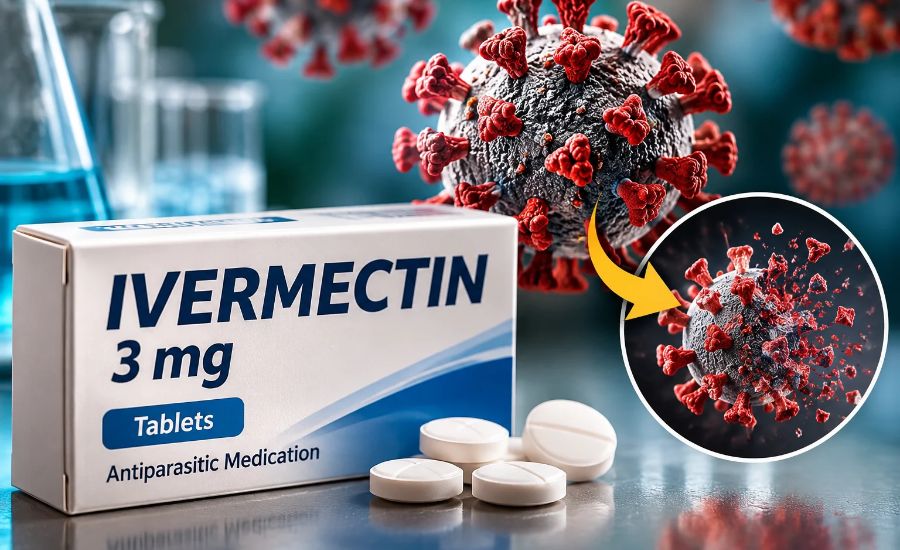

Ivermectin, a medication traditionally used to treat parasitic infections, attracted worldwide attention after researchers discovered that it could significantly reduce SARS-CoV-2 viral RNA in infected cells under laboratory conditions.
The study, published in 2020, reported a nearly 5,000-fold reduction in viral RNA within 48 hours of exposure to ivermectin.
The discovery generated considerable scientific interest and prompted researchers to investigate whether the inexpensive and widely available medication could also be effective against COVID-19 in humans.
However, an important distinction must be made between antiviral activity observed in laboratory experiments and the effectiveness of a medication in actual patients.
What Did the Original Ivermectin Study Discover?
In April 2020, Australian researchers from Monash University and the Peter Doherty Institute published a study in the scientific journal Antiviral Research.
The research team investigated whether ivermectin could inhibit the replication of SARS-CoV-2, the virus responsible for COVID-19.
Scientists infected laboratory-grown cells with the virus before exposing them to ivermectin.
Their findings revealed:
- A substantial reduction in viral RNA within 24 hours.
- An approximately 99.98% reduction in viral RNA within 48 hours compared with untreated samples.
- Continued suppression of viral RNA during the 72-hour observation period.
The results suggested that ivermectin possessed antiviral properties under specific experimental conditions.
However, the experiment was conducted using laboratory-grown monkey kidney cells, not human patients.
What Is Ivermectin?
Ivermectin is an antiparasitic medication that has been used in human and veterinary medicine for decades.
Its discovery transformed the treatment of several parasitic diseases, particularly in regions where these infections represent a significant public health concern.
In 2015, William C. Campbell and Satoshi Ōmura shared part of the Nobel Prize in Physiology or Medicine for discoveries that led to the development of ivermectin.
In human medicine, ivermectin is used to treat conditions including strongyloidiasis, river blindness, and certain forms of scabies and head lice.
Beyond its established antiparasitic properties, scientists have investigated its potential antiviral, anti-inflammatory, and anticancer activities. Many of these applications remain experimental.
How Could Ivermectin Interfere With Viral Replication?
Researchers have proposed that ivermectin may interfere with proteins involved in transporting molecules into the nucleus of infected cells.
Certain viruses exploit these cellular transport mechanisms to interfere with the body’s natural antiviral defenses.
By disrupting these processes, ivermectin may potentially influence viral replication under laboratory conditions.
Previous experimental research has also investigated its activity against viruses such as dengue, West Nile, and influenza.
Nevertheless, a proposed biological mechanism does not automatically establish that a medication will effectively treat viral infections in humans.
Why Did the Laboratory Results Generate So Much Interest?
When the original study was published, the world was facing a new infectious disease with limited treatment options.
Ivermectin appeared to be an interesting candidate for drug repurposing because it was relatively inexpensive, widely available, and had an established history of medical use.
Repurposing existing medications can potentially reduce the time and expense associated with developing entirely new treatments.
However, one of the biggest challenges was the concentration of ivermectin required to achieve the observed antiviral effect.
The concentrations used in the laboratory were considerably higher than those normally achieved in human blood and lung tissue with approved doses.
Attempting to reproduce these concentrations by increasing the dose could expose patients to serious adverse effects.
What Did Subsequent Human Clinical Trials Find?
Following the initial laboratory discovery, researchers conducted numerous clinical trials to evaluate ivermectin as a potential COVID-19 treatment.
Some smaller studies initially reported encouraging outcomes. However, larger and more rigorously designed randomized clinical trials failed to establish meaningful clinical benefits.
The TOGETHER Trial
Published in the New England Journal of Medicine in 2022, the TOGETHER trial compared 679 patients receiving ivermectin with 679 patients receiving a placebo.
Researchers investigated whether early treatment could reduce hospitalization or prolonged emergency medical observation.
The results did not demonstrate a statistically significant reduction in these outcomes among patients receiving ivermectin.
The ACTIV-6 Trial
Another randomized clinical trial, published in JAMA in February 2023, investigated whether a higher dose administered over a longer period could improve recovery from mild to moderate COVID-19.
The researchers found no meaningful improvement in recovery time compared with placebo.
These findings illustrate why promising laboratory discoveries must undergo extensive clinical testing before becoming established medical treatments.
Why Laboratory Results Do Not Always Translate Into Human Benefits
The human body is considerably more complex than a laboratory cell culture.
When a medication is administered orally, it must be absorbed, distributed throughout the body, metabolized, and eventually eliminated.
Several factors can influence its effectiveness, including drug concentration, tissue penetration, immune responses, metabolism, and interactions with other medications.
A substance that demonstrates powerful antiviral activity in laboratory-grown cells may therefore produce very different results when administered to humans.
This does not invalidate the original laboratory discovery. Instead, it highlights the limitations of applying experimental findings directly to clinical medicine.
Is Ivermectin Safe?
Ivermectin has an established safety profile when prescribed appropriately for approved medical conditions.
However, like all medications, it can cause side effects.
Potential adverse effects include nausea, diarrhea, dizziness, headaches, skin reactions, and abdominal discomfort.
Excessive doses may cause serious complications, including dangerously low blood pressure, neurological disturbances, seizures, and loss of consciousness.
Veterinary ivermectin formulations should never be used by humans because their concentrations and ingredients may differ significantly from medications intended for human use.
Is Ivermectin Approved for COVID-19?
The US Food and Drug Administration has not approved or authorized ivermectin for preventing or treating COVID-19.
The European Medicines Agency has also concluded that available clinical evidence does not support its use against COVID-19 outside appropriately designed clinical trials.
Its established medical value as an antiparasitic medication should not be confused with proven effectiveness against viral infections.
Does Ivermectin Have Other Potential Medical Applications?
Scientists continue to investigate ivermectin for potential applications beyond parasitic diseases.
Experimental research has explored its possible role in cancer cell signaling, inflammatory processes, viral replication, and certain bacterial infections.
These investigations are part of a broader scientific effort to discover additional therapeutic uses for existing medications.
However, many of these findings remain limited to laboratory or animal studies and require further clinical validation.
Final Thoughts
The discovery that ivermectin reduced SARS-CoV-2 viral RNA by approximately 99.98% within 48 hours under laboratory conditions is based on genuine scientific research.
However, this finding does not mean that ivermectin eliminates 99.98% of the virus in infected people.
Subsequent large clinical trials have not demonstrated meaningful benefits for routine COVID-19 treatment.
The story of ivermectin serves as an important reminder that laboratory discoveries can open exciting new avenues of research, but human clinical evidence remains essential for determining whether a medication is both safe and effective for a particular disease.
Scientific References:
- Caly L. et al. Antiviral Research, Volume 178, June 2020.
- Reis G. et al. New England Journal of Medicine, 2022.
- Naggie S. et al. JAMA, February 2023.
- European Medicines Agency — Ivermectin and COVID-19, March 2021.
- US Food and Drug Administration — Ivermectin and COVID-19.
- Infectious Diseases Society of America — COVID-19 Treatment and Management Guidelines.




Leave a Reply
You must be logged in to post a comment.