
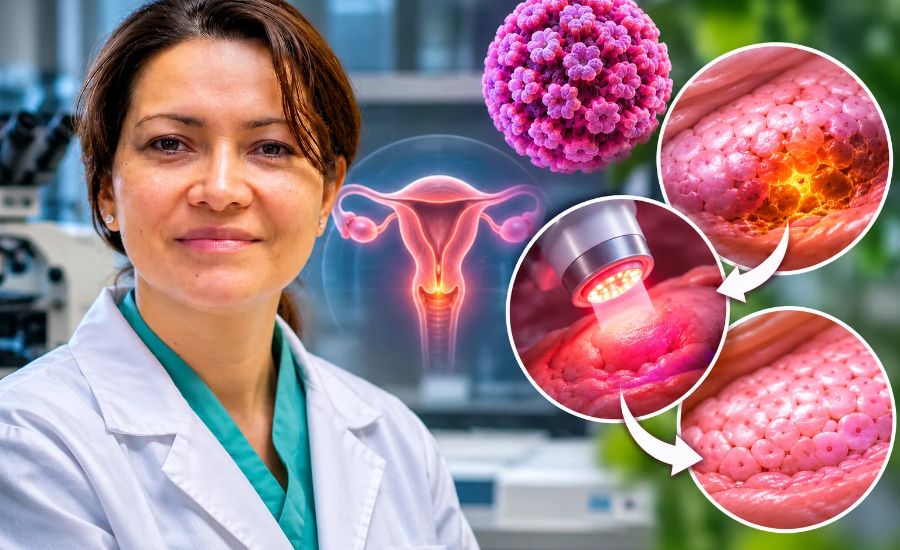

A Mexican scientist and her research team have achieved promising results in the fight against human papillomavirus (HPV), one of the most widespread sexually transmitted infections and the leading cause of cervical cancer worldwide.
Dr. Eva Ramón Gallegos, a researcher at Mexico’s National Polytechnic Institute (IPN), has spent more than two decades investigating the potential of photodynamic therapy to eliminate HPV and treat precancerous cervical lesions.
In a clinical study involving 29 women from Mexico City, the researchers achieved a 100% viral clearance rate among participants who had HPV without precancerous cervical lesions.
The findings were initially announced in 2019, with the corresponding scientific study published in the journal Photochemistry and Photobiology in 2023.
Although the discovery has generated considerable excitement, it is important to understand what the researchers achieved and why further clinical trials are necessary before the technique can be considered a universal HPV treatment.
What Is HPV and Why Is It So Dangerous?
Human papillomavirus is a group of more than 200 related viruses, some of which can infect the skin and mucous membranes.
HPV is extremely common, and most sexually active individuals will encounter at least one type of the virus during their lifetime.
In many cases, the immune system controls the infection naturally within one or two years. However, persistent infections involving high-risk HPV strains can cause abnormal cellular changes that may eventually develop into cancer.
HPV has been associated with several types of cancer, including cervical, vaginal, vulvar, anal, penile and certain throat cancers.
HPV types 16 and 18 are particularly concerning because they account for a substantial proportion of cervical cancer cases worldwide.
One of the biggest challenges is that HPV frequently produces no noticeable symptoms, allowing persistent infections to remain undetected without appropriate screening.
The Mexican Scientist Behind the Promising Discovery
Dr. Eva Ramón Gallegos is a biomedical researcher at the National School of Biological Sciences of Mexico’s National Polytechnic Institute.
Her scientific work has focused extensively on the medical applications of photodynamic therapy, particularly in the treatment of abnormal cells, infections and precancerous conditions.
Together with her colleagues, she investigated whether a specialized light-based treatment could target HPV-infected cervical tissue without requiring conventional surgical removal.
Her team’s research offers a potential new direction in the management of persistent HPV infections.
How Does Photodynamic Therapy Work?
Photodynamic therapy, also known as PDT, combines a light-sensitive substance with a specific wavelength of light to produce a targeted biological reaction.
Unlike conventional surgery, the approach aims to damage abnormal cells while limiting injury to surrounding healthy tissue.
The treatment involves applying a substance called 5-aminolevulinic acid, or 5-ALA, to the affected cervical tissue.
Cells metabolize this substance into a light-sensitive compound known as protoporphyrin IX.
When exposed to a specific wavelength of light, this compound generates reactive oxygen species capable of damaging targeted cells.
Researchers believe this process could help eliminate HPV-infected cells and promote the recovery of affected cervical tissue.
Photodynamic therapy is already used in certain areas of medicine, including dermatology and oncology, although its application as an HPV treatment requires further investigation.
What Did the Study of 29 Women Reveal?
The Mexican researchers evaluated the effectiveness of photodynamic therapy in 29 women with different cervical conditions.
After six months of follow-up, the researchers reported the following results:
- 100% HPV clearance among women who had HPV without cervical lesions.
- 64.3% treatment success among women with HPV and low-grade cervical lesions.
- 57.2% lesion regression among women with cervical lesions but without detectable HPV, although this result was not statistically significant.
The findings suggest that photodynamic therapy may be particularly effective against certain cervical HPV infections.
However, the widely circulated claim that all 29 women were completely cured of HPV is misleading. The 100% clearance rate applied to a specific subgroup rather than every participant in the study.
Could This Treatment Help Prevent Cervical Cancer?
Persistent infection with high-risk HPV strains is responsible for nearly all cases of cervical cancer.
When the virus remains in cervical tissue for extended periods, it can interfere with normal cellular processes and contribute to the development of precancerous changes.
Without appropriate monitoring and treatment, some of these abnormalities may progress into cancer over several years.
A treatment capable of eliminating persistent HPV infections could potentially interrupt this process before malignant tumors develop.
If confirmed in larger clinical trials, photodynamic therapy could become an additional option for selected patients with HPV-related cervical abnormalities.
However, the Mexican study did not directly establish that the treatment prevents cervical cancer or reduces cancer-related deaths.
Potential Advantages of Photodynamic Therapy
Researchers are particularly interested in photodynamic therapy because of its potential to treat affected tissue without surgically removing portions of the cervix.
Potential advantages include targeted treatment, preservation of cervical tissue, limited invasiveness and the possibility of repeated applications.
Preserving cervical tissue could be particularly relevant for younger women concerned about future pregnancies.
Nevertheless, the long-term safety, effectiveness and reproductive outcomes of different treatment protocols require further investigation.
Researchers Also Observed Changes in Cervical Microorganisms
Another interesting aspect of the Mexican study was its investigation of microorganisms associated with cervical and vaginal health.
The researchers evaluated whether photodynamic therapy could influence certain potentially harmful microorganisms alongside HPV.
Their findings suggest that the technique may have applications beyond targeting abnormal cervical cells.
However, additional studies are necessary to determine how treatment affects the vaginal microbiome over time and whether these changes offer meaningful clinical benefits.
Has a Permanent Cure for HPV Finally Been Discovered?
Despite the encouraging findings, it would be premature to describe photodynamic therapy as a definitive cure for HPV.
The original study involved a relatively small number of participants, and HPV can sometimes become undetectable naturally without medical intervention.
Furthermore, a negative HPV test does not necessarily establish that the virus has been permanently eliminated from every affected cell.
Larger controlled clinical trials are needed to determine whether the treatment produces lasting viral clearance, reduces recurrence and works consistently across different HPV strains and patient populations.
Other international studies have investigated photodynamic therapy for HPV-related conditions, but their reported success rates vary considerably.
There is still no established universal treatment that reliably eliminates HPV itself.
Why HPV Prevention Remains Essential
While researchers continue exploring new treatment options, established preventive measures remain essential in reducing the burden of HPV-related diseases.
HPV vaccination can help protect against new infections involving the most dangerous viral strains, while regular cervical screening allows healthcare professionals to identify abnormal cellular changes before they progress.
Condom use can reduce the likelihood of HPV transmission, although it cannot provide complete protection because the virus can spread through skin-to-skin contact.
Avoiding tobacco and attending recommended follow-up appointments are also important, particularly for individuals diagnosed with high-risk HPV.
A positive HPV test does not mean that a person has cancer. Most infections resolve naturally, but persistent high-risk infections require appropriate medical monitoring.
A Promising Discovery That Deserves Further Attention
The research conducted by Dr. Eva Ramón Gallegos and her colleagues represents an encouraging development in the search for new ways to manage HPV-related diseases.
The possibility of using light-activated therapy to target infected cervical tissue offers an interesting alternative to conventional treatment approaches.
Although the results do not establish a permanent or universal HPV cure, they provide a foundation for further clinical research.
For millions of women affected by persistent HPV infections, advances in this field could eventually provide additional treatment options and help reduce the global burden of cervical cancer.
The Mexican research team’s work demonstrates how years of scientific investigation can open new possibilities in disease prevention and treatment.
Scientific reference: López-Cárdenas et al. (2023). Elimination of Human Papillomavirus and Cervical Pathological Microbiota with Photodynamic Therapy in Women from Mexico City with Cervical Intraepithelial Neoplasia I. Photochemistry and Photobiology.
Medical disclaimer: This article is for educational purposes only. Photodynamic therapy should not replace recommended HPV vaccination, cervical screening or prescribed medical treatment.




Leave a Reply
You must be logged in to post a comment.