
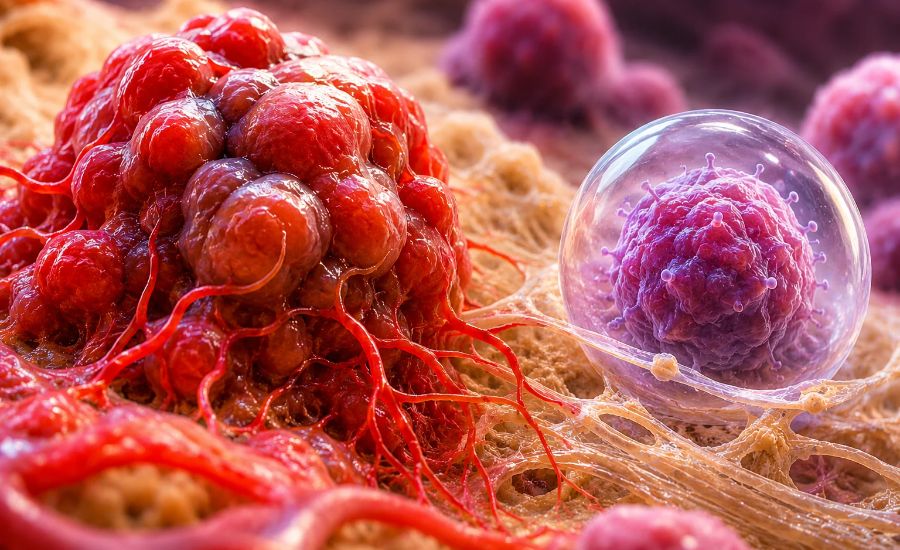

What if the future of cancer treatment involved not only destroying cancer cells but also preventing them from ever waking up?
Researchers at the Icahn School of Medicine at Mount Sinai have identified a specific protein that plays an important role in keeping cancer cells in a dormant state, potentially opening the door to new strategies for preventing cancer recurrence and metastasis.
The protein, known as type III collagen, is naturally present in the human body and appears to influence whether certain cancer cells remain inactive or begin multiplying again.
The findings, published in the scientific journal Nature Cancer in December 2021, offer valuable insights into one of the most challenging mysteries in oncology: why cancer sometimes returns years after seemingly successful treatment.
Why Cancer Can Return Years After Treatment
Even when cancer treatment successfully removes or destroys a tumor, some cancer cells may survive and travel to distant parts of the body.
These cells can remain inactive for years or even decades without producing noticeable symptoms or forming detectable tumors.
This phenomenon is known as cancer cell dormancy.
Unlike actively growing cancer cells, dormant cells may temporarily stop dividing. However, they remain alive and can potentially reactivate under certain biological conditions.
When these cells resume multiplying and establish tumors in other organs, the process is known as metastasis.
Understanding what causes dormant cancer cells to awaken could help scientists develop treatments designed to prevent cancer from returning.
Scientists Identify a Protein That Helps Keep Cancer Cells Asleep
The research team discovered that dormant cancer cells can create a surrounding environment enriched with type III collagen.
Collagen is the most abundant protein in the human body and is an essential component of connective tissues, including the skin, blood vessels, muscles and internal organs.
However, different types of collagen perform different biological functions.
The researchers found that type III collagen was particularly important in regulating cancer cell dormancy in their experimental models.
When sufficient type III collagen was present in the immediate environment surrounding cancer cells, the cells tended to remain inactive.
When this protective environment was disrupted, cancer cells could resume multiplying.
The discovery suggests that the biological environment surrounding a cancer cell may be just as important as the cell itself in determining whether it remains dormant or grows into a tumor.
How Type III Collagen Influences Cancer Cell Behavior
Every cell in the human body exists within a complex network of proteins and other molecules known as the extracellular matrix.
This network provides structural support while also transmitting biological signals that influence cell growth, movement and survival.
Researchers discovered that dormant cancer cells could modify this surrounding network by producing type III collagen.
The protein interacts with a cellular receptor known as discoidin domain receptor 1, or DDR1, influencing signaling mechanisms associated with cellular dormancy.
Disrupting this communication allowed previously inactive cancer cells to resume proliferation in experimental models.
This finding challenges the traditional understanding of cancer progression by highlighting the importance of communication between cancer cells and their surrounding tissues.
Rather than focusing exclusively on destroying cancer cells, future therapies might also target the environment that influences their behavior.
What the Researchers Found During Their Experiments
The scientists investigated cancer dormancy using mouse models, human cancer cell lines and advanced imaging techniques.
Their research included models of breast cancer and head and neck cancer.
Among their most important observations were:
- Dormant cancer cells produced a surrounding matrix rich in type III collagen.
- Type III collagen helped maintain a non-proliferative cellular state.
- Disruption of this collagen-rich environment encouraged cancer cell reactivation.
- Modifying the environment surrounding cancer cells showed potential for suppressing tumor growth.
- Specific cellular signaling pathways appeared to regulate the transition between dormancy and proliferation.
These findings provide an experimental foundation for investigating treatments that could prevent residual cancer cells from developing into metastatic tumors.
However, the research does not establish that the same approach will successfully prevent cancer recurrence in human patients.
Could Keeping Cancer Cells Dormant Prevent Metastasis?
Metastasis is responsible for the majority of cancer-related deaths and remains one of the greatest challenges in modern oncology.
Once cancer spreads to distant organs, treatment often becomes considerably more complicated.
A therapy capable of maintaining cancer cell dormancy could potentially offer several advantages:
Reducing the Risk of Cancer Recurrence
Preventing residual cancer cells from becoming active again could help extend periods of remission.
Preventing Metastatic Tumor Growth
Maintaining disseminated cancer cells in an inactive state might prevent them from establishing new tumors in distant organs.
Supporting Conventional Cancer Treatments
Future dormancy-targeting therapies could potentially complement chemotherapy, radiation therapy, immunotherapy and surgery.
Improving Long-Term Cancer Management
For certain patients, controlling residual cancer cells might eventually become an additional strategy for managing the disease.
These potential benefits remain theoretical until confirmed through appropriate human clinical trials.
Why Dormant Cancer Cells Are So Difficult to Treat
Many conventional cancer treatments are particularly effective against rapidly dividing cells.
Dormant cancer cells, however, may divide very slowly or stop dividing altogether, allowing some of them to survive treatments that target cellular proliferation.
They can also be difficult to detect because they may exist as isolated cells or microscopic clusters rather than visible tumors.
Scientists are therefore investigating several complementary approaches, including maintaining dormancy, eliminating dormant cells directly and identifying biological signals that cause their reactivation.
Understanding these mechanisms could eventually help doctors better assess an individual’s risk of cancer recurrence.
Can Taking Collagen Supplements Keep Cancer Cells Dormant?
Although the discovery involves a naturally occurring form of collagen, it does not mean that consuming collagen supplements can prevent cancer or metastasis.
The study examined specific molecular interactions occurring within the immediate environment of cancer cells.
Consuming collagen powder, bone broth or collagen-rich foods does not necessarily reproduce these conditions.
During digestion, dietary collagen is broken down into amino acids and smaller peptides, which the body can use for various biological functions.
There is currently no reliable clinical evidence demonstrating that oral collagen supplements can maintain cancer cell dormancy or prevent cancer recurrence.
Furthermore, different forms of collagen can influence tumor behavior in different ways, depending on the cancer type and surrounding biological environment.
Patients undergoing cancer treatment should discuss supplement use with their oncology team.
What Can People Do to Support Long-Term Health?
While scientists continue investigating cancer dormancy, established lifestyle recommendations remain important for overall health and cancer risk reduction.
These include maintaining a healthy body weight, exercising regularly, consuming a varied diet rich in plant-based foods, avoiding tobacco, limiting alcohol consumption and attending recommended cancer screenings.
For cancer survivors, following prescribed treatments and attending scheduled medical examinations are particularly important.
Healthy habits can support general well-being, but they cannot guarantee that dormant cancer cells will remain inactive.
A Promising Direction for the Future of Cancer Treatment
The discovery of type III collagen’s role in cancer cell dormancy represents an important development in understanding how cancer progresses and returns.
It suggests that preventing metastasis may require more than attacking cancer cells directly. Scientists may also need to understand and modify the microscopic environment that controls their behavior.
Although the research is still largely preclinical, it raises an intriguing possibility: instead of exclusively trying to eliminate every remaining cancer cell, future treatments might also prevent certain cells from becoming active again.
For millions of cancer survivors living with uncertainty about recurrence, this area of research offers a meaningful reason for cautious optimism.
Scientific research: Di Martino and colleagues, Nature Cancer, Volume 3, 2022. First published December 13, 2021.
Medical disclaimer: This article is for educational purposes only and does not constitute medical advice. The findings described are primarily based on experimental research and do not establish an approved cancer treatment.



Leave a Reply
You must be logged in to post a comment.