
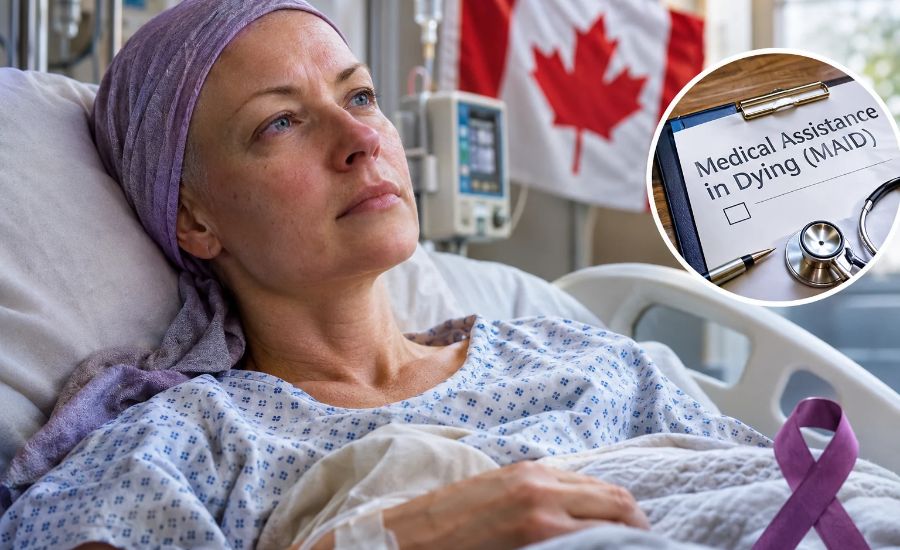

When Kristin Logan moved to Canada with her husband, Donovan James, she believed the country’s publicly funded healthcare system would provide security, financial stability, and access to medical care when she needed it most.
However, after receiving a devastating stage 4 ovarian cancer diagnosis, her experience took an unexpected turn.
Instead of receiving timely cancer treatment, Logan says she encountered lengthy medical delays and was presented with information about Canada’s controversial medical assistance in dying program before meeting with an oncologist.
Determined to pursue treatment, she eventually returned to the United States.
Her story, which received renewed international attention in November 2026, has reignited an uncomfortable debate about patient rights, healthcare accessibility, medical ethics, and the responsibility of healthcare systems toward seriously ill patients.
A Devastating Diagnosis Changed Everything
Logan, a United States Air Force veteran and mother living in British Columbia, was diagnosed with stage 4 ovarian cancer in September 2023.
According to earlier Canadian media reports, she had spent months trying to understand the cause of her deteriorating health before receiving her diagnosis.
Advanced ovarian cancer is a serious condition that requires individualized medical evaluation and treatment. Depending on the patient’s circumstances, treatment may involve chemotherapy, surgery, targeted therapies, and supportive care.
For Logan, however, receiving a diagnosis was only the beginning of another difficult battle: getting access to treatment.
A Missing Referral and Weeks of Uncertainty
Following her diagnosis, Logan expected to receive an appointment to begin cancer treatment.
As the weeks passed, she became increasingly concerned about the lack of progress.
According to Canadian media coverage from November 2023, Logan eventually discovered that there was no record of her chemotherapy referral.
For someone facing advanced cancer, the uncertainty surrounding treatment was particularly distressing.
Her experience attracted public attention in British Columbia, where other patients had also expressed concerns about healthcare delays and access to specialists.
Information About Assisted Dying Before Cancer Treatment
One of the most controversial aspects of Logan’s story emerged through her subsequent interviews.
She reported receiving information about Canada’s Medical Assistance in Dying program, commonly known as MAID, before she had even met with an oncologist.
Logan interpreted the experience as an indication that she was being encouraged to consider death before receiving an adequate opportunity to pursue treatment.
Her husband also expressed serious concerns about how the healthcare system had handled her situation.
Importantly, while Logan’s diagnosis, treatment delays, and decision to seek American healthcare were documented by Canadian news organizations in 2023, the circumstances surrounding the MAID information are based primarily on her personal testimony.
Receiving information about assisted dying is not equivalent to being formally approved for the procedure or being denied cancer treatment in favor of it.
Nevertheless, her account raises significant questions about the timing and sensitivity of such conversations.
She Decided to Seek Treatment in the United States
Unwilling to continue waiting, Logan traveled to the United States to seek cancer care.
Her medical journey was far from easy. In addition to her cancer diagnosis, she subsequently experienced serious intestinal complications that required emergency medical attention.
Despite these challenges, she continued pursuing medical treatment.
In 2026, approximately three years after her original diagnosis, Logan was still alive and publicly sharing her experiences.
Her story does not establish that every patient with advanced cancer can achieve the same outcome. However, it illustrates why individual prognoses, treatment opportunities, and patient preferences deserve careful consideration.
What Is Canada’s Medical Assistance in Dying Program?
Canada legalized medical assistance in dying in 2016.
The program allows eligible individuals experiencing severe suffering associated with qualifying medical conditions to request medically assisted death under a regulated legal framework.
To qualify, individuals must meet specific eligibility requirements, including:
- Being at least 18 years old.
- Having the mental capacity to make healthcare decisions.
- Having a qualifying serious and incurable medical condition.
- Experiencing intolerable suffering associated with their condition.
- Making a voluntary request without external pressure.
- Providing informed consent.
Canadian law also requires independent medical assessments and additional safeguards in certain circumstances.
Supporters of the program argue that it respects personal autonomy and allows eligible individuals experiencing intolerable suffering to make deeply personal end-of-life decisions.
Critics, however, question whether vulnerable patients may feel pressured to consider assisted dying when adequate medical treatment, disability support, pain management, or palliative care is difficult to access.
Canada’s Assisted Dying Program Continues to Grow
According to Health Canada’s report covering 2024, approximately 16,499 people received medical assistance in dying that year, representing a 6.9% increase compared with the previous year.
The program’s growth has generated ongoing discussions among medical professionals, disability rights advocates, ethicists, religious organizations, and policymakers.
One of the central concerns is whether patients can make genuinely autonomous decisions when they face limited access to healthcare, financial difficulties, social isolation, or inadequate support.
At the same time, advocates maintain that restricting access to assisted dying could undermine the rights of eligible individuals who voluntarily request it after careful consideration.
Balancing these concerns remains one of the most complex challenges in modern medical ethics.
Does Stage 4 Cancer Automatically Mean There Is No Hope?
A diagnosis of stage 4 cancer can be overwhelming, but it does not automatically mean that treatment is impossible.
Stage 4 generally indicates that cancer has spread beyond its original location to distant areas of the body.
Treatment outcomes depend on numerous factors, including the type of cancer, its biological characteristics, the patient’s general health, and how the disease responds to treatment.
Modern cancer care may include chemotherapy, immunotherapy, targeted therapies, surgery, radiation therapy, and participation in clinical trials.
Although many advanced cancers cannot currently be cured, treatment may help control disease progression, relieve symptoms, extend survival, and improve quality of life.
Some patients live considerably longer than initially expected, while others experience more aggressive disease progression despite appropriate treatment.
This is why individualized medical assessment and access to oncology specialists are so important.
The Ethical Question: Can Patients Make a Free Choice Without Access to Adequate Care?
Perhaps the most important question raised by Logan’s experience extends beyond Canada’s assisted dying legislation.
Can a patient’s decision truly be considered voluntary if they feel that other medical options are inaccessible?
For patients facing serious illnesses, timely access to specialists, appropriate pain management, psychological support, palliative care, and available treatment options can significantly influence their experiences and decisions.
Palliative care, in particular, is frequently misunderstood. It is not necessarily about abandoning treatment. It can be provided alongside active cancer therapies to improve comfort, manage symptoms, and support patients and their families.
Healthcare systems must ensure that conversations about end-of-life decisions are conducted sensitively, without coercion, and with respect for each patient’s wishes.
Why Patient Advocacy Matters
Logan’s experience also highlights the importance of being actively involved in one’s medical care.
Patients facing serious diagnoses may benefit from:
- Requesting copies of their medical records and test results.
- Following up on specialist referrals.
- Seeking a second medical opinion when appropriate.
- Asking about available treatment alternatives.
- Bringing a trusted family member to medical appointments.
- Requesting assistance from patient advocacy organizations.
- Discussing clinical trials and supportive care options with specialists.
Patients should feel comfortable asking questions and requesting clarification about their medical condition, prognosis, and available choices.
However, ensuring access to appropriate care should remain a responsibility of healthcare institutions, not a burden placed exclusively on patients.
Final Thoughts
Kristin Logan’s experience is more than a personal account of battling advanced ovarian cancer. It highlights the profound consequences that healthcare delays, communication failures, and inadequate support can have on seriously ill individuals.
While the debate surrounding assisted dying remains complex, patients deserve accurate information, compassionate care, timely medical assessments, and the freedom to make informed decisions without pressure.
A serious diagnosis should never diminish a person’s dignity or their right to explore available treatment options.
Ultimately, the quality of a healthcare system must also be measured by how it supports its most vulnerable patients when they need help the most.




Leave a Reply
You must be logged in to post a comment.