
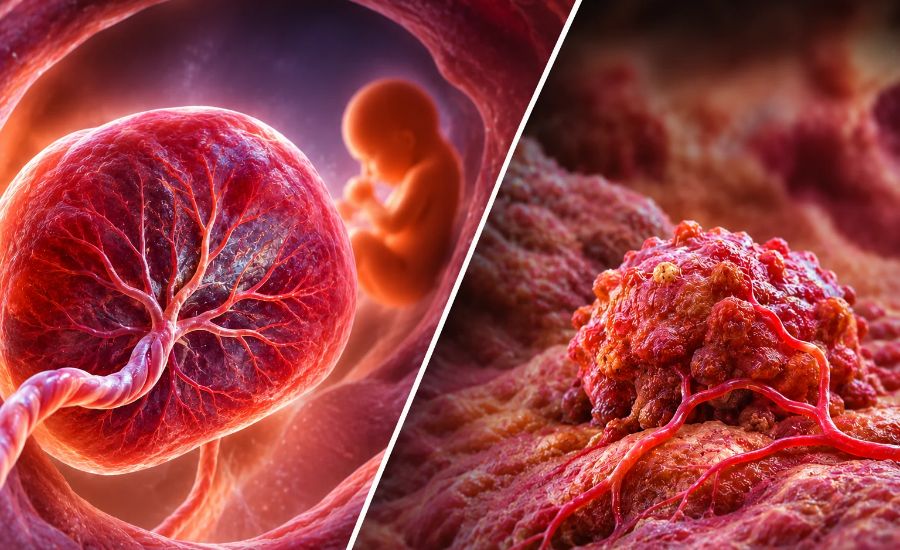

One develops to support the creation of a new life. The other can threaten an existing one. Yet, despite their dramatically different purposes, the human placenta and a cancerous tumor share some remarkably similar biological behaviors.
Both can invade surrounding tissues, stimulate the formation of new blood vessels, adapt to changing oxygen levels, and influence the body’s immune responses.
The difference lies in how these processes are regulated.
During a healthy pregnancy, placental development follows tightly controlled biological mechanisms. In cancer, similar cellular processes can become uncontrolled and destructive.
Scientists are studying these fascinating similarities to better understand both pregnancy complications and the complex mechanisms behind cancer growth.
The Placenta: One of the Most Extraordinary Human Organs
The placenta is a temporary organ that develops during pregnancy, connecting the developing baby to the mother’s body.
It supplies oxygen and nutrients, facilitates the removal of waste products, produces essential hormones, and helps regulate immune interactions between the mother and the developing fetus.
Unlike most human organs, the placenta develops rapidly, performs its functions for a limited period, and is delivered after childbirth.
What makes it particularly fascinating is that its development relies on several cellular mechanisms also observed in cancer.
1. Both Can Invade Surrounding Human Tissue
One of the defining characteristics of malignant cancer cells is their ability to invade surrounding tissues.
Surprisingly, certain placental cells possess a similar ability.
During the early stages of pregnancy, specialized cells called extravillous trophoblasts penetrate the lining of the uterus. They also help remodel maternal blood vessels, establishing the blood supply necessary for fetal development.
These cells produce enzymes that break down components of the extracellular matrix, allowing them to move through surrounding tissues.
Cancer cells can exploit similar molecular mechanisms to invade healthy tissues.
However, there is a fundamental difference. Placental invasion is normally restricted by biological signals that determine where and when it should occur. Cancer cells can escape these regulatory mechanisms and continue invading tissues.
The placenta invades to sustain life, while malignant tumors invade in ways that can destroy it.
2. Both Stimulate the Growth of New Blood Vessels
No rapidly developing tissue can survive without an adequate supply of oxygen and nutrients.
Both the placenta and many cancerous tumors stimulate a process known as angiogenesis, which involves the formation of new blood vessels.
During pregnancy, the development of an extensive vascular network allows the placenta to support the growing fetus.
Cancerous tumors can also stimulate blood vessel formation to obtain the resources necessary for continued growth.
One molecule involved in both processes is vascular endothelial growth factor, commonly known as VEGF.
VEGF helps regulate blood vessel formation and plays an important role in normal development, wound healing, and certain diseases.
Some modern cancer treatments are designed to interfere with angiogenesis, limiting the ability of tumors to develop or maintain their blood supply.
In a healthy pregnancy, however, properly regulated vascular development is essential.
3. Both Can Influence the Immune System
Perhaps one of the most fascinating similarities between the placenta and cancer involves the immune system.
A developing fetus carries genetic material inherited from both biological parents. This means some of its genetic characteristics differ from those of the mother.
Why, then, does the mother’s immune system not normally attack the developing fetus?
The placenta helps establish a specialized immune environment in which maternal immune cells tolerate fetal tissues while maintaining important protective functions.
Some cancer cells exploit comparable immune-regulating mechanisms to avoid recognition or destruction by the immune system.
For example, certain placental cells and tumor cells express molecules such as HLA-G, which can influence immune cell activity.
Researchers are particularly interested in these similarities because understanding immune tolerance during pregnancy could provide valuable insights into cancer immune evasion.
Importantly, normal pregnancy does not simply switch off the mother’s immune system. It involves a complex and carefully coordinated balance between immune protection and tolerance.
4. Both Can Grow Rapidly
The placenta develops from a relatively small population of cells into a complex, highly specialized organ within months.
This requires extensive cell division, tissue organization, and cellular differentiation.
Rapid cellular proliferation is also a characteristic of many cancers.
Both placental and cancer cells can use molecular signaling pathways involved in regulating cell growth, survival, and movement.
However, not all rapidly growing cells are cancerous.
Healthy placental cells receive signals that regulate their development and restrict their behavior. Cancer cells may acquire genetic and epigenetic changes that allow them to ignore such signals.
This distinction demonstrates why rapid growth alone does not define cancer. The loss of normal cellular regulation is a much more important characteristic.
5. Both Can Adapt to Low-Oxygen Environments
During early pregnancy, the developing placenta exists in a naturally low-oxygen environment.
Placental cells are adapted to these conditions, which play an important role in early development.
Similarly, rapidly growing tumors may develop regions where oxygen levels are unusually low because their growth exceeds the available blood supply.
This condition is known as hypoxia.
Both placental and cancer cells can activate biological pathways that help them respond to reduced oxygen availability.
Among the molecules involved are hypoxia-inducible factors, or HIFs, which influence the expression of genes associated with metabolism, blood vessel development, and cellular survival.
In cancer, these adaptations may contribute to tumor progression and resistance to certain treatments.
In pregnancy, carefully regulated oxygen levels and cellular responses are part of normal placental development.
6. Both Share Certain Patterns of Gene Regulation
Another surprising similarity involves epigenetics, the mechanisms that influence how genes are activated or silenced without changing the underlying DNA sequence.
Researchers have identified certain similarities between the epigenetic characteristics of placental tissues and cancer cells.
These include differences in DNA methylation, a biological process that helps regulate gene activity.
Some genes associated with normal placental development are also expressed abnormally in certain cancers.
Scientists are investigating whether these overlapping patterns could help identify potential cancer biomarkers or therapeutic targets.
Nevertheless, sharing certain genetic or epigenetic characteristics does not make the placenta cancerous. Many of the biological mechanisms used by cancer cells originally evolved to perform normal and essential functions throughout the body.
What Happens When Placental Cells Lose Their Normal Regulation?
Although the placenta is not a tumor, abnormal growth of pregnancy-related trophoblast cells can occur.
These disorders belong to a group of conditions known as gestational trophoblastic disease.
They include hydatidiform moles, commonly called molar pregnancies, and rarer malignant conditions such as gestational choriocarcinoma.
Choriocarcinoma is an aggressive cancer that can develop from pregnancy-related trophoblastic tissue and spread to other organs.
Interestingly, gestational choriocarcinoma is often highly responsive to chemotherapy, and many patients can be successfully treated.
These conditions illustrate the importance of the biological mechanisms that normally regulate trophoblast growth and invasion.
However, they are uncommon and should not be confused with ordinary placental development during a healthy pregnancy.
Could Studying the Placenta Help Scientists Fight Cancer?
The similarities between placental and cancer biology have fascinated researchers for decades.
A scientific review published in Mayo Clinic Proceedings in 2009 examined the overlapping mechanisms of tissue invasion, cellular proliferation, blood vessel formation, and immune regulation during pregnancy and cancer.
Another review, published in Biomedicines in 2022, explored how the environments surrounding placental and tumor cells influence their development and behavior.
A separate review published in the Annual Review of Animal Biosciences in 2022 investigated the evolutionary relationship between placental development and cancer biology.
These research areas raise several fascinating questions:
- How does the placenta naturally limit cellular invasion?
- Can similar regulatory mechanisms be used to restrict cancer growth?
- Could placental immune regulation help scientists understand how tumors escape immune detection?
- Could shared molecular characteristics reveal new cancer biomarkers?
- What causes some cells to stop responding to normal biological restrictions?
These questions represent promising avenues for scientific investigation. However, the similarities have not established placental tissue as a cancer treatment, and many potential applications remain experimental.
Does This Mean the Placenta Is a Type of Cancer?
Absolutely not.
The human placenta is a normal, temporary organ that performs essential physiological functions during pregnancy.
Although certain placental cells display behaviors resembling those of malignant cells, their activities are normally coordinated and regulated.
Cancer, in contrast, is characterized by abnormal cellular growth and a loss of normal regulatory control, with malignant tumors capable of invading and damaging surrounding tissues.
The similarities do not mean that pregnancy is a form of cancer or that normal placental development causes cancer.
Instead, they demonstrate how the same fundamental biological mechanisms can produce dramatically different outcomes depending on how they are regulated.
Final Thoughts
The human placenta and a cancerous tumor represent two profoundly different biological processes, yet they share some of the same cellular tools.
Both can invade tissues, stimulate blood vessel formation, influence immune responses, and adapt to challenging environments.
One of the most remarkable differences is that the healthy placenta knows, through its biological regulatory mechanisms, when and where to limit these activities.
Cancer can lose that ability.
Perhaps one of the most fascinating lessons from placental biology is that understanding how the human body successfully controls cellular invasion could eventually help scientists understand how to control it when it becomes destructive.
Sometimes, the secrets of disease may be hidden within the very processes that make life possible.


Leave a Reply
You must be logged in to post a comment.