
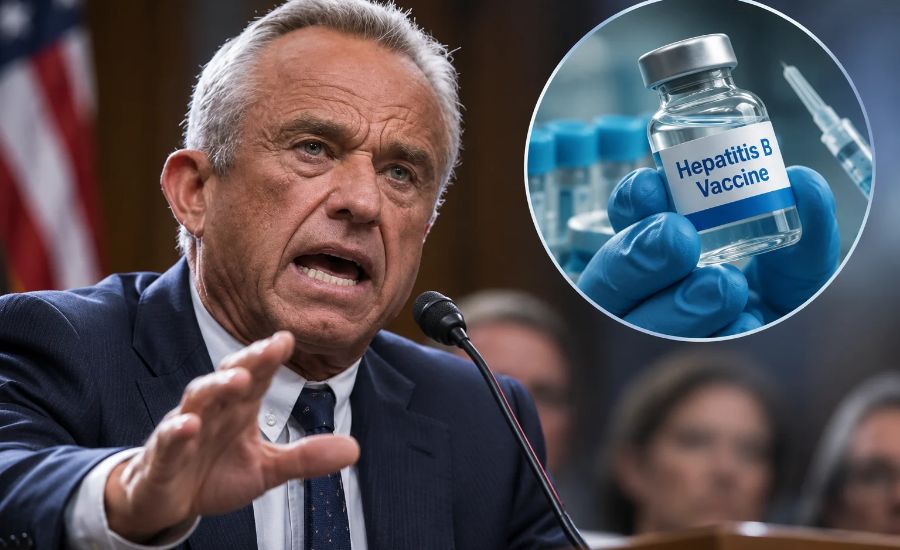

A controversial allegation by Robert F. Kennedy Jr. has reignited debate over childhood vaccination, autism research, and transparency at America’s leading public health agency. But the extraordinary statistic at the center of the controversy has a complicated scientific history.
Robert F. Kennedy Jr., the U.S. Secretary of Health and Human Services, has accused the Centers for Disease Control and Prevention (CDC) of concealing research that he claims identified a dramatic increase in autism risk among children who received the hepatitis B vaccine shortly after birth.
The allegation centers on an extraordinary figure: a purported 1,135% increase in autism risk.
Kennedy has argued that early CDC research revealed a concerning association between childhood vaccination and autism, but that subsequent analyses obscured the original findings.
His statements have attracted widespread attention, particularly among parents concerned about vaccine safety, medical transparency, and the growing number of children diagnosed with autism spectrum disorder.
However, independent examinations of the research have found that the statistic does not establish a causal relationship between hepatitis B vaccination and autism. The allegation of a deliberate CDC cover-up also remains unsupported by the available evidence.
Where Did the 1,135% Autism Risk Claim Come From?
The controversy traces back to research conducted in the late 1990s by CDC scientist Thomas Verstraeten and colleagues.
The researchers examined information from the Vaccine Safety Datalink, a large database designed to investigate possible adverse health outcomes following vaccination.
Their work explored whether exposure to thimerosal, a mercury-containing preservative historically used in certain vaccines, was associated with neurodevelopmental diagnoses.
Preliminary analyses examined children with different levels of exposure to thimerosal during early infancy.
Kennedy has repeatedly claimed that an early analysis identified an exceptionally elevated autism risk among children vaccinated against hepatitis B during their first month of life.
However, the figure’s origins raise important questions.
A relative-risk estimate of 11.35 appeared in a 2004 presentation by SafeMinds, an organization that has advocated investigating possible relationships between vaccines and autism.
That presentation attributed the estimate to early CDC data obtained through a Freedom of Information Act request.
Crucially, the figure was associated with a category of thimerosal exposure, not an established finding that the hepatitis B vaccine independently increased autism risk.
The presentation also did not provide the complete statistical information needed to properly evaluate the estimate, including its confidence interval.
Furthermore, a relative risk of 11.35 mathematically represents a 1,035% increase over baseline, not 1,135%.
This discrepancy illustrates why the original figure requires careful scrutiny.
Kennedy Claims the CDC Changed Its Findings
Kennedy has suggested that CDC researchers repeatedly modified their analyses until the apparent relationship between vaccination and autism disappeared.
He has characterized the process as evidence that health officials sought to minimize potentially damaging findings.
The allegation raises a significant question: were the results intentionally manipulated, or were researchers refining preliminary findings through standard scientific procedures?
Initial research findings frequently change when investigators account for additional variables, expand their datasets, or correct limitations in their analytical methods.
In epidemiology, researchers must distinguish between a statistical association and a causal relationship.
Factors such as birth year, underlying health conditions, differences in healthcare access, and diagnostic practices can influence results.
Failure to account for these variables can produce misleading estimates.
The Verstraeten research underwent further investigation, and the peer-reviewed analysis published in 2003 did not identify a consistent, statistically significant association between thimerosal exposure and autism.
Although Kennedy has interpreted the revisions as evidence of concealment, publicly available documentation and subsequent scientific reviews do not establish that the CDC deliberately suppressed evidence of a vaccine-related autism risk.
What Did the Published Research Actually Find?
The research associated with Verstraeten and colleagues was ultimately published in Pediatrics in 2003.
The study examined thimerosal exposure from vaccines and several neurodevelopmental outcomes.
Its findings did not support a consistent causal association between thimerosal-containing vaccines and autism.
This distinction is important because preliminary statistical signals are not equivalent to confirmed medical findings.
Researchers may initially identify apparent associations that disappear when larger populations or more appropriate analytical techniques are used.
For example, children receiving vaccines earlier may differ from those vaccinated later in ways that influence the likelihood of receiving a developmental diagnosis.
Unless researchers adequately control for these differences, an apparent association may reflect confounding rather than a biological effect of vaccination.
For this reason, conclusions should be based on the strongest available evidence rather than isolated preliminary estimates.
What About Other Studies Linking Hepatitis B Vaccination to Autism?
The controversy does not involve only one research project.
A 2010 study by Carolyn Gallagher and Melody Goodman examined hepatitis B vaccination during infancy and reported autism diagnoses among boys using historical U.S. survey data.
The researchers reported an association suggesting that boys vaccinated during their first month of life had approximately three times the odds of a parent-reported autism diagnosis compared with boys vaccinated later or not vaccinated during that period.
However, the study had important limitations, including its observational design, potential confounding, and reliance on reported diagnoses.
In May 2026, the journal formally retracted the study after an independent statistical review identified fundamental methodological problems that made its conclusions unreliable.
The retraction is particularly relevant because the paper had frequently been cited in debates about hepatitis B vaccination and autism.
Meanwhile, a larger Vaccine Safety Datalink cohort analysis involving more than 110,000 children found no significant association between hepatitis B vaccination during the first month of life and a subsequent autism diagnosis.
A CDC evidence review presented in September 2025 also acknowledged that results from individual studies were inconsistent, while identifying the largest and methodologically stronger study as finding no relationship.
Taken together, the research does not substantiate the claim that hepatitis B vaccination causes autism.
Why Is the Hepatitis B Vaccine Given to Newborns?
Hepatitis B is a viral infection that attacks the liver.
Although some infections resolve naturally, others become chronic and can eventually lead to cirrhosis, liver failure, or liver cancer.
Infection during infancy is especially concerning.
Approximately 90% of infants infected with hepatitis B develop chronic infection, compared with a much smaller proportion of adults.
For decades, public health authorities have recommended hepatitis B vaccination during early childhood because preventing infection early can dramatically reduce the risk of serious liver disease later in life.
The vaccine is designed to stimulate an immune response against the virus without exposing the child to an actual hepatitis B infection.
Common adverse reactions include temporary soreness at the injection site, mild fever, or fatigue. Serious allergic reactions are rare.
The timing of newborn hepatitis B vaccination has become a subject of renewed political and medical debate in the United States.
In December 2025, a CDC advisory committee voted to move toward individualized decision-making for infants born to mothers who test negative for hepatitis B.
The proposed policy change generated significant controversy, with medical organizations emphasizing the importance of timely protection against a potentially lifelong infection.
Questions about vaccination schedules are legitimate subjects for scientific investigation, but they should be evaluated separately from unsupported claims about autism causation.
Does Scientific Research Support a Connection Between Vaccines and Autism?
Autism spectrum disorder is a neurodevelopmental condition involving differences in communication, social interaction, behavior, and sensory processing.
Its causes are complex, with genetic factors playing a substantial role. Researchers continue to investigate how genetic and environmental influences interact during development.
Over several decades, scientists have examined whether childhood vaccines contribute to autism risk.
Large population-based studies, systematic reviews, and international scientific assessments have consistently failed to establish a causal relationship.
In December 2025, the World Health Organization’s Global Advisory Committee on Vaccine Safety reaffirmed that the available evidence does not support a causal link between vaccines and autism.
A September 2026 WHO evidence review likewise supported the safety of current vaccines with respect to autism spectrum disorder and other neurodevelopmental conditions.
Although no single scientific study can answer every conceivable question about vaccine safety, the overall body of research is far more informative than an isolated preliminary statistical estimate.
Why Have Autism Diagnoses Increased?
One reason the vaccine-autism debate continues is the documented increase in autism diagnoses over recent decades.
Parents and policymakers understandably want to know what explains this trend.
However, an increase in recorded diagnoses does not necessarily mean that a new environmental exposure is responsible.
Several factors may contribute to rising identification rates, including broader diagnostic criteria, improved awareness, earlier screening, greater access to evaluation, and changes in how autism is recognized among different populations.
Researchers also continue to investigate potential biological and environmental influences.
Importantly, the timing of an autism diagnosis after vaccination does not establish that the vaccination caused the condition.
Many developmental differences become noticeable during the same early-childhood period when routine immunizations are administered.
Distinguishing coincidence from causation requires carefully designed research.
The Bigger Question: Should the CDC Release More Historical Vaccine Data?
Beyond the scientific disagreement, Kennedy’s allegations have renewed discussion about transparency in public health research.
Public confidence depends not only on scientific evidence but also on how clearly institutions explain their findings.
Releasing research protocols, statistical methods, and appropriately de-identified data can help independent investigators assess controversial claims.
Such transparency can also clarify why preliminary analyses differ from final published results.
However, there is a difference between requesting greater access to historical research and asserting that an agency deliberately concealed evidence.
The former is a reasonable demand for accountability.
The latter requires credible documentation demonstrating intentional misconduct.
At present, the publicly available evidence does not substantiate Kennedy’s allegation that the CDC hid proof of a dramatic hepatitis B vaccine-related increase in autism risk.
What Should Parents Take Away From This Controversy?
Parents should be able to ask detailed questions about vaccine safety, side effects, ingredients, and vaccination schedules.
They should also receive accurate explanations of what research has established, what remains uncertain, and how public health recommendations are developed.
The reported 1,135% figure is not a confirmed scientific finding demonstrating that hepatitis B vaccination increases autism risk.
It comes from disputed interpretations of preliminary historical data rather than a validated conclusion from a large, rigorous clinical investigation.
The broader scientific evidence does not support hepatitis B vaccination as a cause of autism.
At the same time, continuing independent research and transparent safety monitoring remain important for maintaining trust in vaccination programs.
Parents considering vaccination decisions should discuss their child’s individual circumstances, maternal hepatitis B screening results, and infection risks with a qualified healthcare professional.
Final Thoughts
Robert F. Kennedy Jr.’s accusation against the CDC has brought renewed attention to decades-old vaccine research and the question of how government health agencies communicate scientific findings.
The claim that an internal study discovered a 1,135% increase in autism risk is undeniably attention-grabbing.
But a dramatic percentage cannot be interpreted independently of the underlying research, its methodology, statistical uncertainty, and subsequent findings.
The available scientific evidence does not confirm the alleged increase, establish that the hepatitis B vaccine causes autism, or demonstrate that the CDC deliberately concealed such a finding.
The larger issue is how to ensure that legitimate questions about medical safety receive transparent, evidence-based answers without confusing preliminary research with established scientific conclusions.
As the debate continues, one question remains worth discussing: How can public health agencies make their research more transparent while ensuring that preliminary findings are not mistaken for proven medical risks?

Leave a Reply
You must be logged in to post a comment.